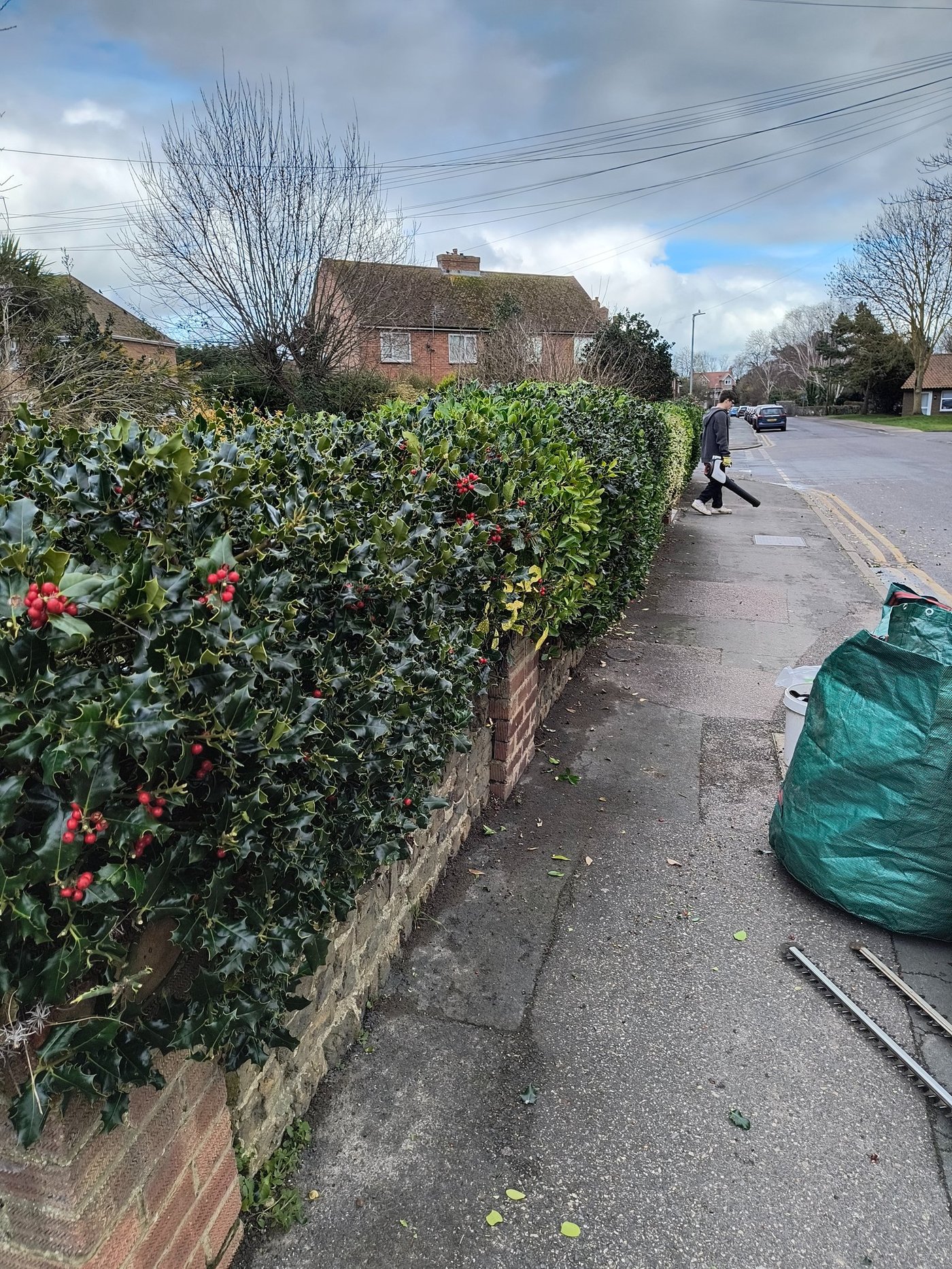
Most people trim their hedges when they notice them. That's fair enough. But if you time it right, you get a denser hedge, a cleaner finish and you stay on the right side of the law, which matters more than most folk realise.
Here's what we actually do, month by month. Kent-specific. No lofty horticultural prose.
The one rule everything else works around
It is an offence to damage a nest that's in active use. Nesting season runs roughly from 1 March to 31 August. If there are birds in your hedge, you wait. Full stop. So the "proper" cutting window for most hedges is September to February, with a light summer trim allowed only if the hedge is definitely empty.
The calendar
January & February, the quiet months
Cold, damp, nothing much growing. A good time for renovation cuts on deciduous hedges like beech, hornbeam and hawthorn, you can see the shape properly without all the leaves in the way. Avoid evergreens when it's actually freezing (cut edges can get frost-damaged).
March, stop and look
This is when nesting kicks off. Have a proper look before you touch anything. If there's a robin eyeing you up and flying in and out of the same spot, leave it. March is fine for a light tidy if the hedge is clearly empty, but we tend to ease off by the middle of the month.
April & May, don't
Don't. Nesting is in full swing. This is when we catch up on the rescue and shaping jobs we couldn't do in winter, and we only touch hedges that are demonstrably empty (usually newer, open hedges you can see right through).
June, the light trim window
For fast growers, privet, box, photinia, a light summer trim keeps them sharp. Go over the hedge carefully first, from underneath, looking for nests. If it's clear, a gentle cut with hedge shears is grand. Don't go hard, that's for later.
July, still be careful
Most birds have fledged by now, but there are always late nesters. Pigeons in particular will have three or four broods. Check, check again, then trim lightly if you must.
August, the green light, gently
Late August is when we really start. Privet, leylandii, laurel, photinia, beech, yew, hornbeam, holly, pretty much everything takes well to a cut now. The hedge has one last growth spurt before autumn, so a cut in late August gives it time to "heal in" the new edges before winter.
September & October, peak season
This is the main cutting window for most Kent gardens. Mild enough for the plant, dry enough for the clippings to stay off the lawn, and the nesting question's settled. If you only cut once a year, cut now.
November & December, final tidies
Perfect for deciduous hedges and for the last formal cut before Christmas. Yew and box take nicely. Avoid hard cuts on leylandii this late, the hedge won't recover before spring.
Species quick-reference
Privet
Light trim in June (if empty), main cut late August or September. Fast grower, very forgiving.
Beech & hornbeam
One cut in late July or August is enough. Keeps the coppery winter leaves, worth the wait.
Yew
Late August to early September. Slow grower, shapes beautifully, tolerates hard cuts better than most.
Box
One careful cut in late May or early June, plus a tidy in August. Watch for box blight, don't trim in wet weather.
Leylandii & conifers
May through September is the safe window. Stay inside the green, see our leylandii guide for the detail.
Laurel
Late summer, after fledging. Use secateurs rather than shears if you want to avoid the shredded-leaf look.
If you get nothing else from this: wait until late August, and always look for nests before you start. That's 90% of getting it right.
Rather we just did it?
We're out cutting hedges across Sandwich, Deal, Worth, Ash, Woodnesborough, Eastry and Sandwich Bay. Send a photo for a free quote, most hedges booked in the same week.