August is a transitional month. The first three weeks are still subject to the same legal and practical cautions as June and July. Then, from around the last ten days of the month, the picture changes: most breeding birds have finished for the year, the nesting season ends formally on 31 August, and the main cutting season begins.
Around Sandwich Bay and Deal, the mild coastal climate of East Kent means summer growth continues well into September, which is good news for any species you cut in late August. The cutting window from late August through to the end of November is the main event of the hedge-care year, and August is when you plan it, prepare for it and, cautiously, start it.
Always check before you cut in August
The nesting season under the UK Wildlife and Countryside Act 1981 ends on 31 August. However, woodpigeons, collared doves and house sparrows can raise broods at almost any time of year, including September. Even after 31 August, a quick visual check before cutting costs nothing and avoids a potential offence. If you see a bird flying in and out of the same spot repeatedly, wait two weeks before cutting that section. See our full guide to checking a hedge for birds' nests.
Before you start: August-specific safety points
- Check for wasp nests first: August is peak wasp season. Dense hedges, particularly privet, laurel and leylandii, are common nest sites. Before cutting any section, look for a steady stream of wasps flying in and out. If you find a wasp nest, leave that section alone until October when the colony has died back.
- Eye protection: safety glasses or goggles for any powered cutting. Foliage is dense and fast-moving debris common.
- Ear defenders: both petrol and electric trimmers exceed safe noise levels quickly.
- Gloves: close-fitting, cut-resistant for spiny species. In August, look out for blackberries in and around the hedge base.
- RCD adaptor: essential for corded electric trimmers. No exceptions.
- Heat awareness: August work in full sun can be exhausting. Work in the morning, take breaks, keep water to hand.
The August decision tree: when to start cutting
The most common August question is simply: can I cut yet? The answer depends on the date and what you see when you look at the hedge.
Work through this before picking up the trimmer
- Is it before 20 August? Treat this like late July. You can cut if you are confident the hedge is empty, but the risk of a late brood (particularly pigeons and sparrows) is still real. Watch the hedge for five minutes before starting. Any bird entering and leaving a specific spot means stop, do not cut that section.
- Is it after 20 August? The main window is opening. The majority of breeding birds in East Kent have finished by mid-August, and the remaining risk is primarily from woodpigeons and house sparrows. A quick visual check remains sensible, but you are not likely to find active nests in most established hedges.
- Can you see a nest with eggs or unfledged chicks? Stop. Put the trimmer down. Under the Wildlife and Countryside Act 1981, even after 31 August, an active nest with eggs or young birds is protected. Leave that section and return in two weeks.
- Is the hedge clearly open, with no signs of bird activity? Start with the species that benefit most from an early cut (see below). Work from the outside in, giving any remaining birds a chance to move on as the structure becomes less dense.
- Unsure? Wait until 1 September and check again. Missing a few days at the start of the season is not a significant cost; inadvertently disturbing an active nest is an offence.
Which hedges to cut in August: species by species
Privet: a good early-August candidate
Privet is one of the fastest-growing hedging species and has often put on a significant amount of growth through the summer. It can be cut throughout August, with the caveat that you check for nests first. A privet hedge on a typical domestic boundary in Sandwich, Deal or Worth is usually clear of nesting activity by the first week of August in most years. The August cut keeps it looking respectable before the main autumn tidy.
Privet can take two cuts a year: one in late June or July and a second in late August or September. The second cut in late August takes off the new growth from the first half of summer and sets the hedge up for a good winter profile.
Leylandii and conifers: late August onwards
Leylandii can be cut from late August through to October. August cutting works well because the plant is still actively growing and can put on new growth quickly to cover cut surfaces before the colder weather slows it down. Avoid cutting leylandii in the first half of August if you want the cuts to green over before autumn: the growth rate is declining and a late-August cut recovers better than an early-August one.
Thuja and lawson cypress follow the same logic. One trim per year in late summer to autumn is the standard approach. Western red cedar can be trimmed in late August if it has been well maintained; do not cut into old brown wood on any conifer species, as it will not regenerate.
Beech and hornbeam: late August is ideal
The timing of the annual beech trim matters more than with most species. A beech hedge cut in late August, after the new growth has hardened off, tends to retain its brown leaves through winter. These papery russet leaves, held on the branches until the new growth pushes them off in spring, give the hedge a warmer appearance through the grey months. A beech cut in October or November sometimes fails to produce this effect, as the leaves may be too mature by then to hold on.
For hornbeam, the same principle applies. Cut in late August after the new growth is firm. Hornbeam is slightly more tolerant of later cuts than beech, but the late-August window still produces the best result for winter appearance.
Yew: late August, but not too late
Yew can be trimmed from late August, but it benefits from being cut before the end of September. The reason is frost hardening: yew cut in October or November has less time to harden the new cut surfaces before the first frosts, which can cause browning on the exposed faces. An August cut gives the plant six to eight weeks to harden the surfaces before the cold arrives.
Yew is one of the most precisely responsive hedging plants in terms of timing. In East Kent's generally mild autumns, a late September cut usually works without frost damage, but August or early September is the safer window if you want a consistently clean finish year on year.
Laurel: late August through September
Laurel can be cut from late August. The key thing with laurel is to use secateurs or loppers on the main stems rather than a hedge trimmer, which cuts through the large leaves and produces brown-edged results that look poor for months. Cutting stem by stem, taking each branch back to a healthy side shoot or bud, is slower but produces a far cleaner finish. For a large laurel hedge, a hedge trimmer on the sides and secateurs on the top is a reasonable compromise.
Holly: August is generally not the right time
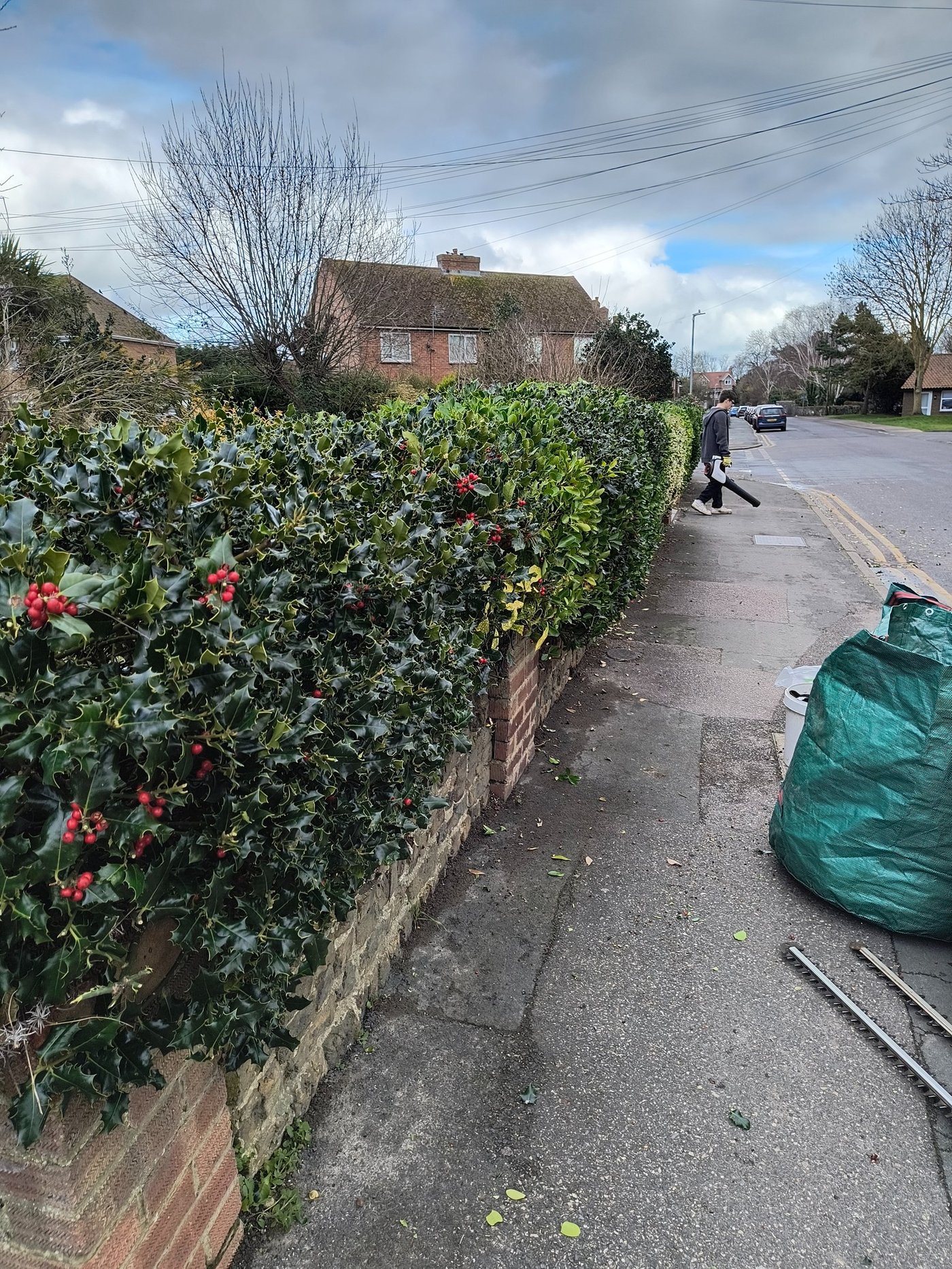
Holly is best cut in late autumn, November or December, to show a clean fresh finish over winter and to salvage berry-laden cuttings before they are wasted. An August cut on holly is not harmful, but the new growth that follows can look untidy by December. If your holly hedge is very overgrown and needs significant work, an initial August tidy is a reasonable first step in a two-year renovation programme.
Box: leave until September
Box responds well to a clean trim in August or September, but the September timing is slightly preferable for most East Kent gardens. The August heat can stress box that is already under drought pressure, and the September trim goes into slightly cooler, moister conditions that suit recovery better. If your box is in good health and you want a clean finish before September, an August trim is fine.
The other August priorities
Watering in drought
August is often the driest month in East Kent. Newly planted hedges planted in the previous autumn or spring need consistent watering through any August drought. Established hedges on chalk and sandy soils, common around Sandwich, Worth and the coastal strip near Deal, can show drought stress in a dry August: drooping or yellowing leaves, particularly on privet and laurel. A thorough watering along the root run, 10 to 15 litres per metre, followed by a bark chip mulch to lock moisture in, is the best response. See our summer drought hedge care guide for the full approach.
Book now for September: the main season fills fast
From mid-August, hedge contractors in East Kent start filling their autumn diaries. September, October and November are the peak months for domestic hedge trimming, and available slots go quickly. If you want your hedge cut in the main season, August is the right time to make contact. Most jobs around Sandwich, Deal, Worth, Ash, Woodnesborough, Eastry and Sandwich Bay can be quoted from a photograph without a site visit for straightforward domestic hedges.
The end-of-August garden planning video STOP! Finish these TEN garden jobs by end of August covers the wider range of garden tasks with a late-August deadline, with hedges as one of the central themes. A useful overview if you are trying to prioritise what to tackle before September arrives.
The thirty-first of August does not mean cut immediately. It means the window is open. Check first, start with the easy species, and save the slower-growing hedges for September when the rush calms down.
Want it done properly before the season fills up?
We start the main cutting season in late August and work through to November across Sandwich, Deal, Worth, Ash, Woodnesborough, Eastry and Sandwich Bay. We check for nests before every cut, know which species to cut first, and always check for wasp nests before starting. Get in touch for a free quote and we will fit you in before the diary fills.
Related guides
Summer hedge care: June and July
What the nesting season means in practice, which species can still be trimmed and the maintenance jobs that fill the summer months.
Read the guide TimingSeptember hedge cutting checklist
The main cutting season is fully open. What to cut first, the species order, and the tasks that set hedges up well for winter.
Read the guide