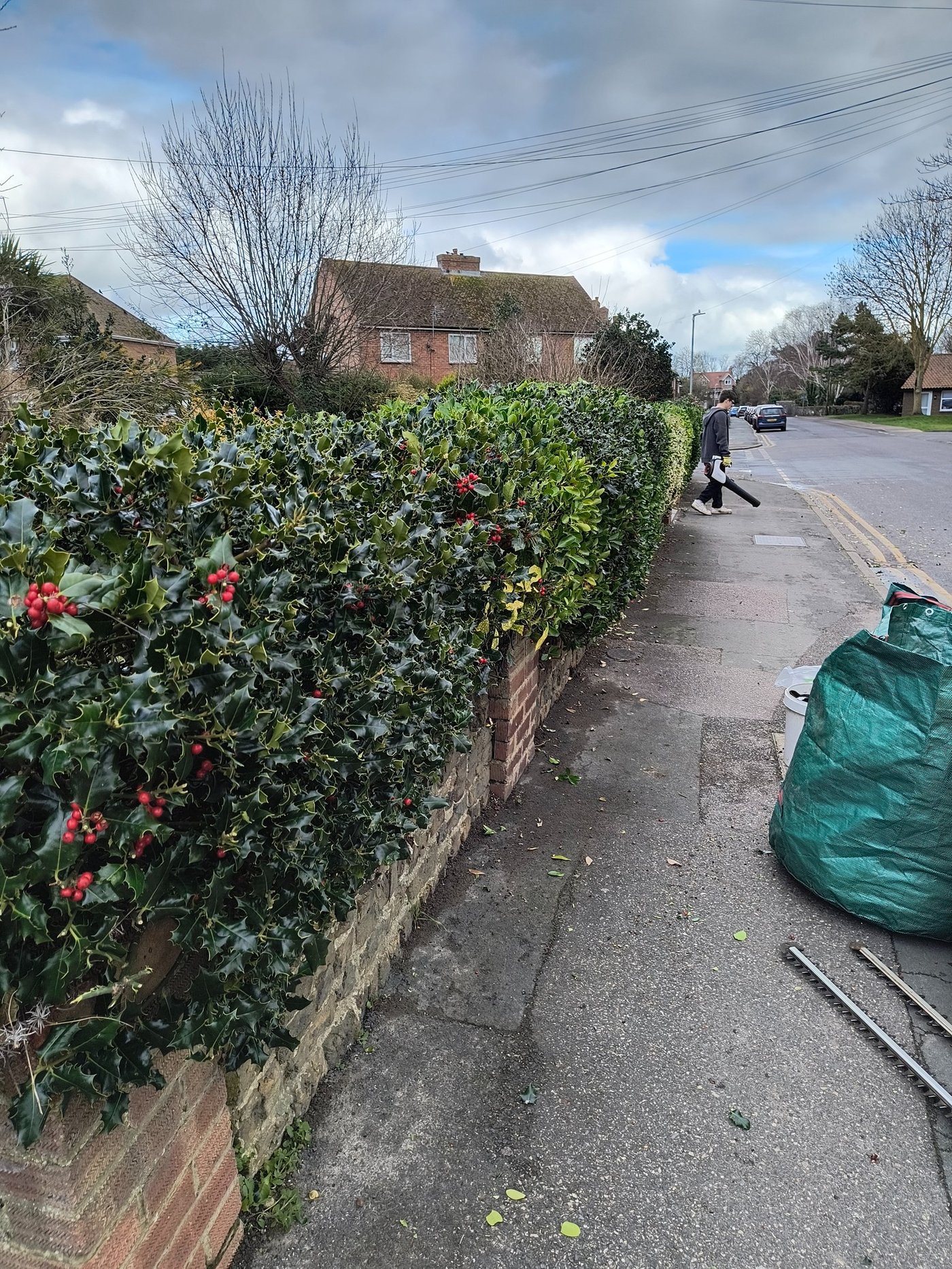
People reach for bamboo when they want screening that goes up fast, stays green all year and takes up less ground than a traditional hedge. In East Kent that usually means someone wants to block a fence line, a neighbours' window or the road from a corner plot in Sandwich, Deal or one of the villages. Done correctly, a clump-forming bamboo screen is genuinely low-maintenance once it settles in. Done with the wrong species, you spend years trying to contain running rhizomes spreading under your lawn.
This guide covers the right bamboos for Kent conditions, how to plant them, and how to keep them looking good without them taking over.
Nesting season: September is actually the right time to act
Under the UK Wildlife and Countryside Act 1981 it is an offence to damage or destroy a nest that is actively in use. Nesting season runs roughly from 1 March to 31 August. Dense bamboo clumps are used by wrens, dunnocks and sparrows as nesting sites, so avoid cutting or hard maintenance on an established clump between March and August unless you are certain it is unoccupied. September to February is the safe window for any structural trimming or thinning work.
Clump-forming vs running bamboo: choose the right one
This is the single most important decision. Get it wrong and you will spend years pulling up shoots from flower beds, paths and neighbouring gardens.
Clump-forming bamboos (Fargesia species) produce new canes from a slowly expanding central clump. They do not send underground runners through the garden. They are the right choice for the vast majority of East Kent gardens.
Running bamboos (Phyllostachys and several other genera) send rhizomes outward underground, sometimes several metres in a single season. They can fill a large area quickly, which sounds useful until those rhizomes reach next door's garden, your paving or the foundations of a boundary wall. If you choose a running bamboo, a root barrier (a continuous underground membrane, at least 60 centimetres deep, installed as a complete ring) is not optional. In most domestic gardens, a Fargesia is simply easier.
Good varieties for Kent gardens
East Kent's sandy and chalk-based soils south and east of the A256 are reasonably well-drained, which suits bamboo. The mild coastal winters around Sandwich Bay and Deal mean frost damage is rare with any of the hardy Fargesia varieties. Further inland towards Ash, Woodnesborough and Eastry, temperatures can drop a few degrees lower, but established Fargesia plants handle most Kent winters without trouble.
| Variety | Height | Character | Best for |
|---|---|---|---|
| Fargesia murielae (umbrella bamboo) | 3–4 m | Arching canes, bright green, dense | Taller screens, sheltered spots |
| Fargesia rufa (dragon head bamboo) | 2–2.5 m | Orange-red new canes, compact clump | Smaller gardens, pots, windy spots |
| Fargesia nitida (fountain bamboo) | 3–4 m | Purple-green canes, shade-tolerant | Shaded positions, north-facing |
| Fargesia robusta (clumping bamboo) | 3–5 m | Upright, striking white cane sheaths | Taller screens, sunny positions |
All four carry the RHS Award of Garden Merit. Fargesia rufa is the most tolerant of exposed coastal positions and handles the salt-laden wind off the Channel better than the others.
Before you start
Safety before you cut
- Eye protection is essential. Cut bamboo canes split into sharp fibres that travel unpredictably. Use wrap-around safety glasses rather than open-frame goggles.
- Sturdy gloves: cut bamboo stem ends are sharp enough to pierce thin gloves. Use leather or heavy-duty work gloves.
- Ear defenders for any petrol or prolonged electric tool use.
- Prefer a long-reach pole trimmer for taller bamboo rather than a ladder. A ladder on soft or uneven ground is the cause of the majority of garden accidents. Only use a ladder where a pole trimmer genuinely will not reach, and always have someone footing it.
- RCD protection for any corded electric tool. Never use a corded trimmer without an RCD adaptor plugged into the socket, not the tool.
- Check for wasp nests and brambles before you start, particularly in established clumps where the base can be hidden.
How to plant a bamboo screen: step by step
Step 1: Prepare the site
Bamboo does best in moist but free-draining soil with some organic matter. Heavy clay soils as found in parts of inland Kent benefit from improving with well-rotted compost or bark mulch before planting. Sandy soils around Sandwich and Sandwich Bay are naturally free-draining but can dry out quickly, so water retention matters more there. Avoid waterlogged ground: Fargesia will sit and sulk rather than establish.
Step 2: Mark the planting line
For a straight screen, stretch a string line and mark plant positions with canes before you dig. For a clump-forming bamboo screen, spacing of one metre between plants gives a continuous screen within two to three growing seasons. At 1.5 metres apart you get a slightly looser feel but the plants are still close enough to link up in time.
Step 3: Dig and plant
Dig each hole roughly twice the width of the root ball and the same depth. Loosen the base of the hole with a fork. Place the plant so the top of the root ball sits at ground level, not buried or raised. Backfill with the excavated soil, firm down with your boot and water in thoroughly.
Step 4: Mulch well
Apply a 5 to 8 centimetre layer of bark mulch or composted wood chip over the root area immediately after planting. This retains moisture through Kent's dry summer spells (the chalky and sandy soils of the Sandwich area dry out faster than heavier soils inland), suppresses weeds and keeps the roots cool. Keep the mulch away from the base of the canes.
Step 5: Water through the first two summers
Newly planted bamboo needs consistent watering for the first two summers. A Fargesia that dries out in its first year will spend years trying to recover rather than establishing a proper screen. Once the clump is settled from year three onwards, established bamboo is significantly more drought-tolerant.
Annual care
Once established, clump-forming bamboo needs less attention than most hedge species. The key jobs, done in late winter or early spring, are:
- Remove dead canes. Cut them out at ground level with loppers or a pruning saw. Dead canes are grey-brown rather than green or yellow-green. Removing them opens the clump and keeps it looking tidy.
- Thin congested clumps. On older plants (five years and over) the base can become dense with old and new canes. Removing the oldest, thinnest canes encourages the plant to put energy into stronger new growth.
- Feed in spring. A general-purpose granular fertiliser applied in March or April gives the plant what it needs for the season's new cane production. High-nitrogen feeds encourage lush green growth but can make canes soft, so avoid chicken-pellet overfeeding.
Trimming the screen
Clump-forming bamboo does not require clipping in the way a formal hedge does. The natural arching shape of Fargesia is one of its attractions. However, if the screen is encroaching on a path, a wall or a neighbouring space, you can cut canes back at ground level to reduce the width of the clump. You cannot push a bamboo back into old wood the way you can with yew or beech, so take off a modest amount at a time rather than going hard all at once.
To reduce the height of individual canes, cut them at a node (a joint in the stem) rather than mid-cane. A cut mid-cane leaves a stub that turns brown and looks untidy. Cut to a node and the cane heals cleanly.
For inspiration on clump-forming bamboo in UK garden conditions, the YouTube guide The Best Clump Forming Bamboo You Can Grow: Fargesia Guide (video ID: opsgvRpS4fk) covers the range of Fargesia varieties in a UK context. We have not been able to verify the exact like count for this video as YouTube is currently not accessible from our automated tools, but the content is consistent with general UK horticultural guidance.
Clump-forming bamboo is one of the lower-maintenance screening options once it is in. The main work is the first two summers of watering. After that, it largely looks after itself.
Need a screen installed or an overgrown bamboo thinned?
We work across Sandwich, Deal, Worth, Ash, Woodnesborough, Eastry and Sandwich Bay. Send a photo for a free quote. Most jobs booked within the week.
Related guides
Hedges for privacy in Kent
The fastest-growing and most effective species for blocking a view, from privet to leylandii and beyond.
Read the guide SpeciesSalt-tolerant hedges for coastal Kent
Which hedge species handle the Channel wind and salt at Sandwich Bay, Deal and Pegwell Bay.
Read the guide