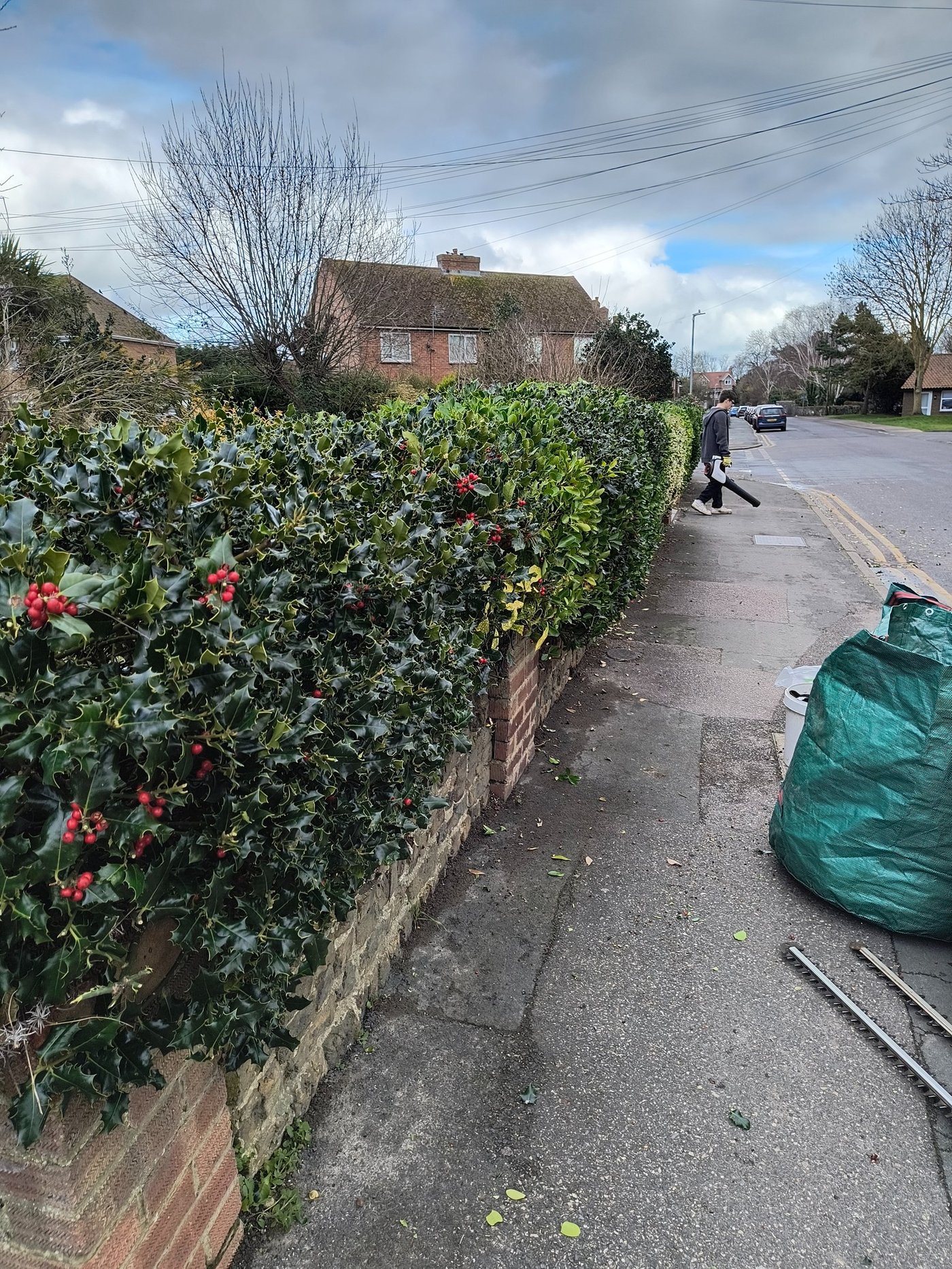
A lot of East Kent's older hedgerows have been left to their own devices for decades. The result is often a line of tall, thin stems with bare bases, no berries at eye level and very little cover for anything. Coppicing fixes this by cutting the stems back hard to near ground level. The roots respond by pushing up a dense thicket of new growth. Within three years, what was a gappy barrier becomes one of the best bits of wildlife habitat in the garden or field margin.
This is not the same as topping a hedge. It is a more drastic cut, done on purpose, in the right season, to specific species that can handle it.
Nesting season: 1 March to 31 August
The Wildlife and Countryside Act 1981 makes it a criminal offence to damage or destroy an active bird's nest. Coppicing cuts deeply into the hedge, so it must be done outside the nesting season. The safe window is November to February. Any work from 1 March onwards requires a thorough visual check for active nests first, and any section with an occupied nest must be left completely alone until the chicks have fledged.
Before you start: safety
Coppicing a hedgerow involves cutting stems up to arm-thickness with powered or hand tools. Wear eye protection (flying chips and thorns are a real hazard, especially from hawthorn and blackthorn), heavy leather gloves, and ear defenders if you are using a chainsaw or petrol trimmer. Sturdy footwear is essential: the cut stumps left in the ground are sharp. Keep bystanders well clear of the cutting zone. If any stems are above head height, consider whether a professional is better placed to do this safely.
Step by step
Step 1: Decide which section to coppice this year
Never coppice the whole hedgerow at once. The rule of thumb is one-third in any given year, ideally one-quarter if the hedgerow is a significant wildlife corridor. Work along the hedge in sections, leaving at least two-thirds standing to provide berries, cover and structure while the cut section grows back. Mark your section with canes before you start so you do not drift.
Step 2: Check the species
Walk the section and identify what you are cutting. Hazel, hawthorn, blackthorn, field maple, elm (where it survives) and dogwood all coppice reliably. Holly can be coppiced but is slow to regenerate. Oak produces good coppice from young stems. If you have yew, beech or any conifer in the section, do not cut them hard: yew regrowth after severe cutting is unpredictable, beech regenerates poorly from old wood, and conifers will not reshoot from bare wood.
Step 3: Gather the right tools
For stems up to about 4–5cm diameter, a good pair of loppers or a Grecian pruning saw is enough. For anything thicker, a bow saw or, if you are confident and trained, a small chainsaw. Have a wheelbarrow or tarpaulin nearby to collect the cut material as you go, and something to transport it: a bonfire or a green waste contractor, or chipped for mulch if you have a chipper.
Step 4: Make the cuts
Cut each stem to between 10 and 30cm above ground level, leaving a short stump. The height matters less than the angle: cut at a slight angle so water does not pool on the flat surface. Cleaner cuts heal faster and are less prone to rot. Avoid tearing or splitting the base of the stem. Where stems have crossed and fused at the base, separate them carefully before cutting; do not try to force loppers through a bunch of stems at once.
Step 5: Clear the cut material from the base
This is important. Piled woody debris left tight against the stumps can harbour fungal disease and shade out the new shoots. Rake or pull all the cut stems clear of the stumps. Stack brash in a loose pile nearby if you can: dead hedges (rows of stacked brash) make excellent cover for small mammals.
Step 6: Protect regrowth if deer or rabbits are a problem
In East Kent's more rural parishes around Worth, Ash and Eastry, rabbits and roe deer will browse new coppice shoots heavily. Tree tubes or spiral guards on individual stumps, or a temporary post-and-wire fence along the coppiced section, give the new growth a chance to establish. Remove the guards once the stems are above deer browse height (about 1.2m).
Step 7: Leave it alone
Do not be tempted to trim the regrowth in the first year. The long, straight shoots are doing the work of building up root reserves. By year two you can begin to weave or lay some of the longer hawthorn stems if you want to thicken the base further, but leave hazel rods to grow straight if you want a proper coppice crop.
What to expect, year by year
Year one: The stumps look stark for a few weeks, then push up clusters of straight shoots, often faster than you expect. By the end of the first growing season the hazel stools in particular will have sent up rods 60–90cm tall. Hawthorn is a little slower but just as vigorous.
Year two: Growth accelerates as the root system catches up to the new canopy. The base of the hedge begins to thicken. You will notice wren and dunnock activity in the lower tangle well before the main hedge canopy has reformed.
Year three: The coppiced section is often the densest part of the hedgerow by now. Berry production resumes on hawthorn and blackthorn. If you coppiced on a rotation, you can begin the next section this winter.
A note on the video below
The demonstration below is from Teagasc, Ireland's national Agriculture and Food Development Authority, showing their hedgerow coppicing technique. The principles are directly applicable to the mixed native hedgerows of East Kent: the same hazel, hawthorn and blackthorn species, the same winter timing, and the same phased approach. The video was featured as a practical resource by Hedgelink, the UK's leading hedgerow management partnership.
Video: How to coppice a hedge by Teagasc (Ireland's Agriculture and Food Development Authority). Used for educational reference.
Species notes for East Kent hedgerows
Hazel is the best coppice species in the county. East Kent's chalk and clay soils suit it well and the stumps push up a dozen or more straight rods in the first season. Traditional hazel coppice on a 7–10 year rotation was the backbone of rural crafts across the Weald and the North Downs.
Hawthorn is the dominant hedgerow shrub in East Kent. It coppices reliably and the new growth is very thorny, which actually makes it more effective as a stock barrier than an overgrown, leggy hedge. Give it 15 years between coppice cuts rather than the tighter rotations used for hazel.
Blackthorn responds vigorously and will sucker from the roots as well as from the stump. This can be useful for filling gaps but do plan for it: blackthorn thickets spread if left unchecked. The suckers can be pulled up by hand for the first two years before they establish deeply.
Field maple is less common than it should be in Kent hedgerows, but where it occurs it coppices beautifully, with attractive palmate leaves on the regrowth. It makes a good companion to hazel in a mixed native hedge.
Need a hand with a neglected hedgerow?
We carry out hedgerow renovation and coppicing work across Sandwich, Deal, Worth, Ash, Woodnesborough, Eastry and Sandwich Bay. Send us a photo for a free quote. Most jobs can be booked within a fortnight in the winter window.