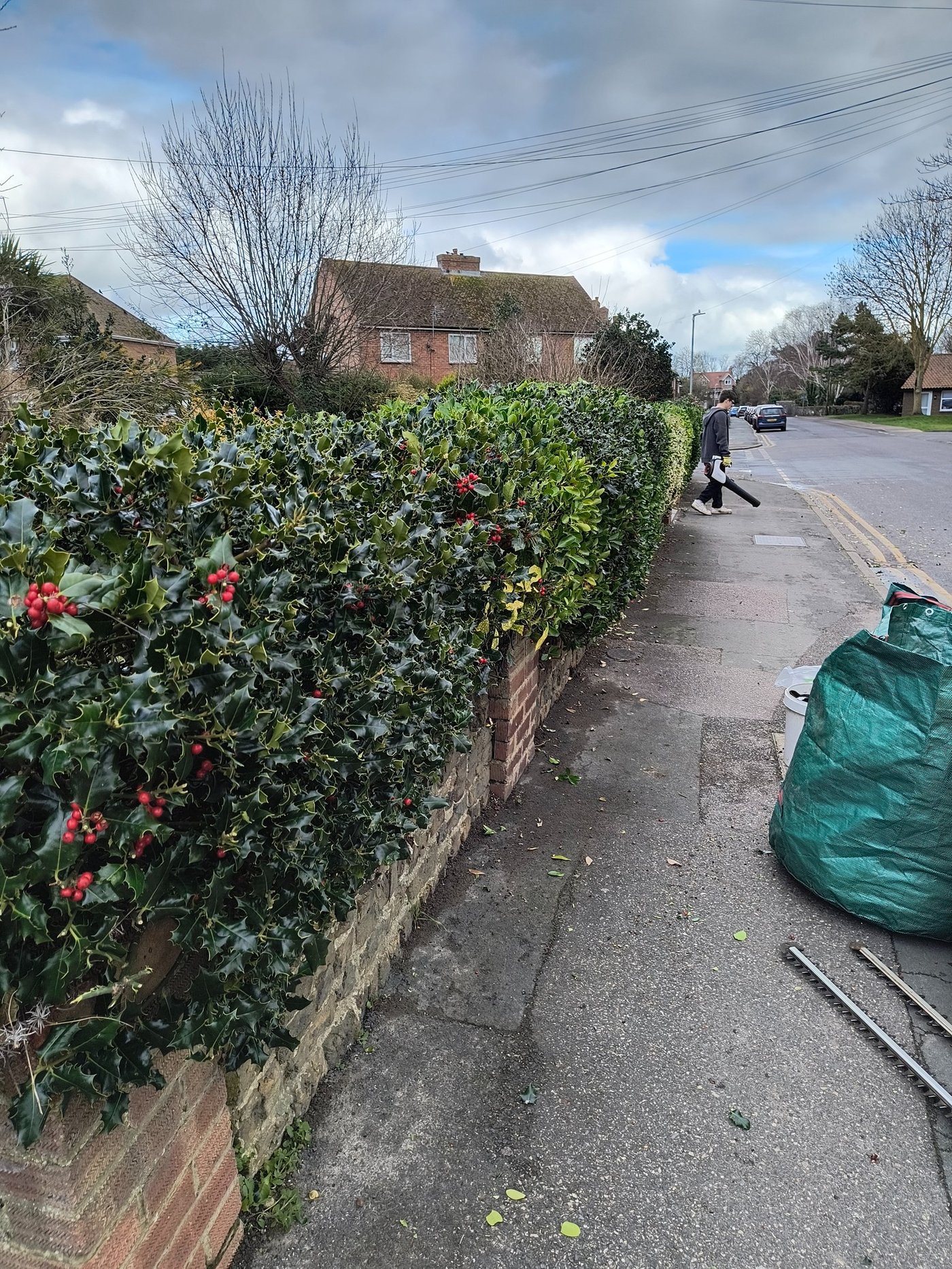
The quick checklist for a Hooper's Rule survey
- Mark a 30-metre section of the hedgerow with canes at each end.
- Walk the section slowly on both sides where possible.
- List every distinct woody species rooted in or at the base of the hedge.
- Do not count bramble, ivy, traveller's joy or other climbers.
- Count each species only once per 30-metre section, however many times it appears.
- Multiply the total number of species by 110.
- The result is a rough estimate of the hedgerow's age in years.
- Cross-check against tithe maps or estate maps for confirmation.
What is Hooper's Rule?
In the 1970s, ecologist Dr Max Hooper analysed hundreds of hedgerows across England, comparing their species diversity with historical records. He found a consistent relationship: hedgerows accumulated roughly one additional woody species every 110 years. A 30-metre section of a hedge planted in the 1800s tends to have two or three species. The same length of a hedge marking a Saxon or Norman boundary might have six, seven or eight.
The rule is a blunt instrument. It works best on hedgerows over 400 years old where species diversity has had time to accumulate; it is less reliable on post-enclosure hedgerows of the 18th and 19th centuries, which were often planted as monocultures or near-monocultures and can appear younger than they actually are. But it is quick, requires no specialist equipment and gives a useful first-pass estimate that can be confirmed with documentary evidence.
East Kent has some of the oldest intact hedgerow networks in England. The parish boundaries around Sandwich, Worth and Eastry follow boundary hedges that in some cases predate the Domesday Book. If your property backs onto a field boundary in this area, there is a genuine chance it is several centuries old.
Step-by-step: doing the survey
Step 1: Mark your 30-metre section
Pace out 30 metres and mark both ends with a cane, a stone or a peg. The 30-metre standard is important: too short and a single clump of one species skews the count; too long and you risk sampling two hedgerows or a section that has been replanted at different times. If the hedgerow has an obvious break (a gap, a gate, a planted section that is visually different), treat each continuous stretch separately.
Step 2: Walk the section slowly
Walk the inside of the hedge bank first, then the outside if access allows. You are looking for woody plants, both the main shrub layer and any tree species that have established themselves in the hedge line. Take your time: hawthorn can look like blackthorn at a quick glance, and field maple is easily overlooked when not in leaf.
Step 3: Identify each woody species
Common East Kent hedgerow species to look for: hawthorn (Crataegus monogyna), blackthorn (Prunus spinosa), hazel (Corylus avellana), field maple (Acer campestre), ash (Fraxinus excelsior), oak (Quercus robur), holly (Ilex aquifolium), elder (Sambucus nigra), rose species (Rosa canina and others), crab apple (Malus sylvestris), spindle (Euonymus europaeus), guelder rose (Viburnum opulus), dogwood (Cornus sanguinea), and elm (Ulmus species, often surviving as sucker regrowth after Dutch elm disease).
Step 4: Decide what to count and what to leave out
Count only woody species that are rooted in or at the very base of the hedge bank. Do not count bramble (Rubus fruticosus), ivy (Hedera helix), traveller's joy (Clematis vitalba), honeysuckle (Lonicera periclymenum) or other climbers. These are common in old hedgerows but their presence reflects habitat conditions rather than age, and including them would inflate the count. Trees growing within about 1 metre of the hedge bank can reasonably be included.
Step 5: Apply the formula
Multiply your species count by 110. A count of 3 gives an estimate of approximately 330 years, placing the hedge in the late 1600s. A count of 6 gives approximately 660 years, into the medieval period. A count of 2 suggests a hedgerow planted within the last 200–250 years, probably from the enclosure era.
Step 6: Cross-check with maps
Tithe maps from the 1830s–1840s are available for most Kent parishes and show field boundaries as they existed before large-scale agricultural change. If a hedgerow appears on the tithe map, it is at least 180 years old. The Ordnance Survey first-edition maps (mostly 1860s–1880s) show even finer detail. For pre-19th-century boundaries, estate maps and parish terriers held at the Kent History and Library Centre in Maidstone sometimes go back to the 1600s or earlier.
Why age matters legally
The Hedgerow Regulations 1997 restrict the removal of countryside hedgerows. Anyone wishing to remove one gives the local planning authority (LPA) written notice, and the LPA has 42 days to respond. GOV.UK says a hedgerow is "important", and protected, if it is at least 30 years old and meets at least one of the criteria in the Regulations. If it does, the LPA can issue a retention notice and removal is refused.
The criteria for importance include: historical significance (for instance, marking a pre-1850 parish boundary), ecological value (home to protected species such as dormice or certain bat species), archaeological significance (adjacent to a scheduled monument) and, most relevantly for age surveys, a sufficiently diverse species count under the Hedgerow Survey Handbook methodology.
A hedgerow does not have to be ancient to qualify: it must meet only one of the criteria listed in Schedule 1 of the regulations. But a genuinely old hedgerow, particularly one on a historic parish boundary, is far more likely to meet several criteria simultaneously.
GOV.UK says the Regulations cover hedgerows on or next to land such as agricultural or forestry land, land used for horses, common land, village greens and nature conservation sites. A hedgerow in, or marking the boundary of, a private garden is not protected. Age counts towards "important" status, but it is not the only test: the criteria include historic boundaries, archaeological features, protected species and the number of woody species. If you are unsure whether your hedgerow qualifies, contact your local planning authority before doing anything irreversible. See our guide to hedgerow regulations and removal for the full steps.
A quick example from East Kent
As an illustration, imagine a field boundary hedge that, surveyed over a 30-metre section, contains: hawthorn, blackthorn, hazel, field maple, elder, spindle and dog rose. That is seven species. Applying Hooper's Rule: 7 × 110 = 770 years. That would suggest a hedgerow of several centuries' age, and if a tithe map or older map shows the same boundary, that backs it up. Hooper's Rule is only a rough guide, not proof of a planting date, and the 30-metre section used here is a simplification of the original method. A hedgerow like this could well be considered "important" under the Hedgerow Regulations, but that is for the planning authority to decide.
The same kind of hedgerow exists on dozens of farm margins and rural property boundaries between Sandwich Bay and Eastry. Not every one has been surveyed, and many owners have no idea what they have.
Thinking of removing or significantly altering a field boundary?
If you are unsure about the legal position, check with your local planning authority before you start. We can advise on hedgerow management that maintains the structure rather than removing it. Get in touch for a conversation.