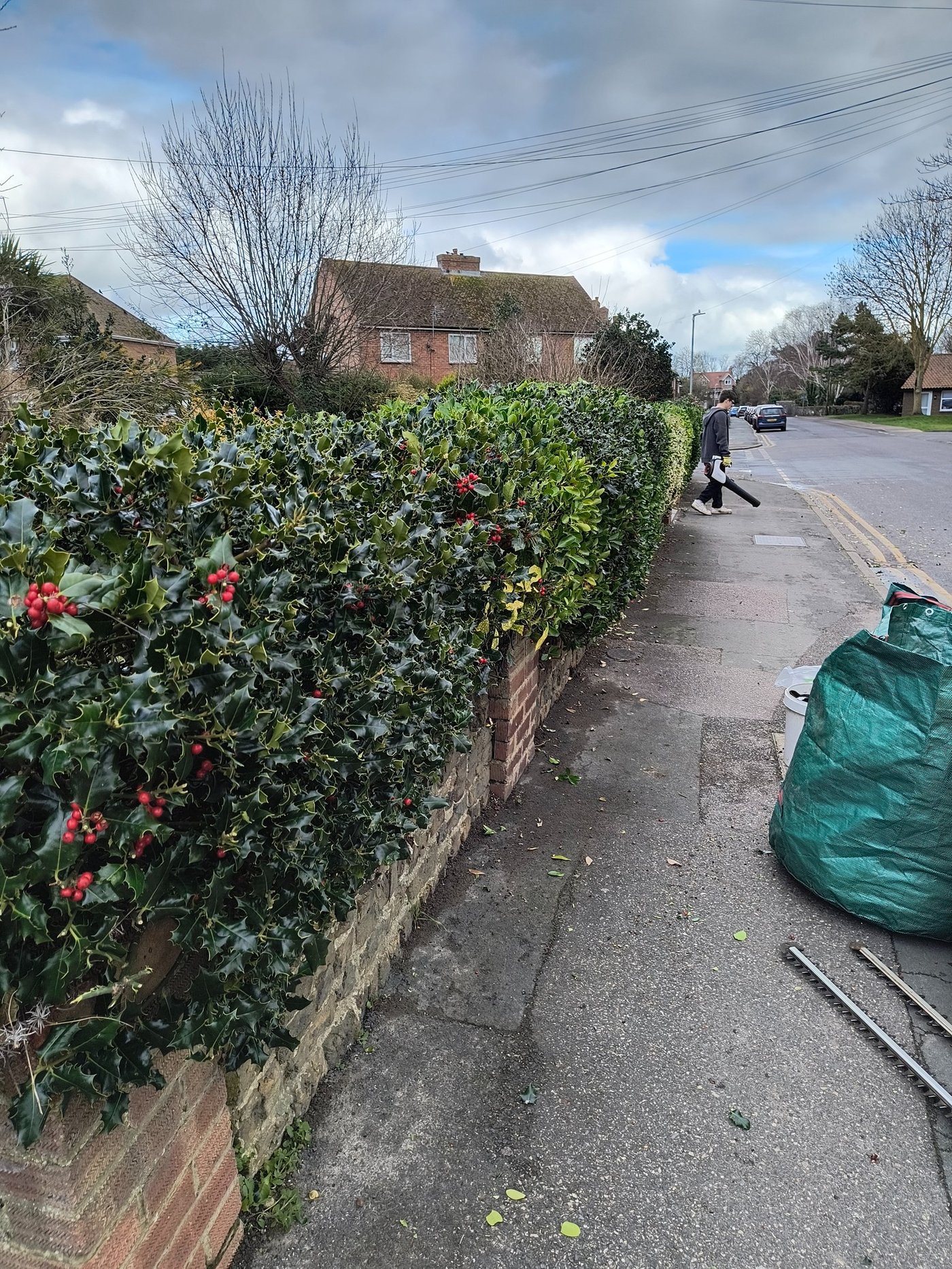
What is instant hedging?
Instant hedging refers to pre-grown hedge plants supplied as long, continuous root-ball troughs, or as individual root-balled specimens of 1 metre or more. The plants have been grown on in long containers by specialist nurseries, often for three to six years before sale, and arrive already forming a continuous green screen at the height you buy.
Unlike bare-root plants (supplied as dormant sticks in winter) or standard container-grown plants (supplied in individual pots), instant hedging is supplied at a height that gives immediate privacy. You dig a trench, lower the trough in, backfill and water. On day one it looks like a hedge rather than a row of sticks.
The three options compared
The table below sets out the main differences. Costs are approximate based on 2024 to 2026 UK nursery pricing for beech or hornbeam at equivalent heights.
| Factor | Bare-root (dormant season) | Pot-grown (any season) | Instant hedging (trough/root-ball) |
|---|---|---|---|
| Relative cost per metre | Lowest | Middle | Highest |
| Planting season | November to March only | Year-round (water in summer) | Year-round (water in summer) |
| Height on day 1 | 20 to 80 cm typically | 30 cm to 1.2 m typically | 60 cm to 2 m+ |
| Time to screen height | 2 to 5 years | 1 to 3 years | Immediate |
| Species choice | Very wide (most native species) | Wide | More limited (popular species only) |
| Establishment watering | Low (dormant roots settle easily) | Moderate | High (large root zone needs regular water in first season) |
| DIY-friendly? | Very (light, easy to handle) | Yes | Possible for short runs; longer troughs are heavy |
When instant hedging makes sense
You need privacy now, not in three years
New-build gardens on the outskirts of Deal, Ash or Sandwich often arrive as open plots with no screening at all. If you are sitting out in the garden from spring onwards and a fence is not what you want, instant hedging is the only option that delivers privacy in the same season it is planted. The cost is real but so is the benefit.
A single section needs replacing
If part of an established hedge has died back (through disease, drought stress or vehicle damage) and the rest is already at height, bare-root infill plants will look visibly different for several years. An instant-hedge section at matching height fills the gap without the mismatch.
A high-visibility formal boundary
For a formal yew or hornbeam hedge fronting a property in a town centre location, the difference between a finished hedge and a row of young plants is visible from the road. Instant hedging removes that awkward establishment period.
When to choose bare-root or pot-grown instead
Large areas or tight budgets
For a 30-metre boundary hedge, the cost difference between bare-root and instant hedging can be very large. A healthy bare-root hedge of beech, hornbeam or hawthorn planted in a well-prepared trench and mulched properly will close up in three to four years. In most situations, patience and a good planting job outperforms the premium.
Native hedgerow mixes
If you want a native mixed hedgerow with hawthorn, blackthorn, field maple, hazel and spindle, bare-root plants are almost always the practical choice. The mix is cheaper, planting conditions are ideal in winter, and the wildlife value of native hedgerow species is the same whether they were planted as small sticks or larger units. See our guide to planting a native hedge in Kent for more detail.
The species is not available as instant hedging
Griselinia, escallonia, photinia and many less common species are often unavailable as trough hedging from standard suppliers. For salt-tolerant coastal planting in Sandwich Bay or along the Deal seafront, bare-root or pot-grown material is frequently the only option.
How to plant instant hedging
The principles are the same as conventional hedge planting, with two differences: the trench is wider and deeper, and watering commitment in year one is greater.
- Mark out and dig a trench. Width should match the trough width plus 15 centimetres either side. Depth should equal the root-ball depth plus 10 centimetres for backfill. In the heavy clay soils around Ash and Eastry, fork the base of the trench to improve drainage.
- Improve the soil. Mix well-rotted compost or planting compost into the excavated soil at a ratio of roughly one part compost to three parts existing soil. Do not use pure compost as a backfill medium.
- Lower the trough or root-ball carefully. Longer trough sections are heavy; two people are useful. Position the plant so the soil surface of the trough sits level with or very slightly above the surrounding ground level.
- Backfill and firm. Work soil in around the root zone in layers, firming gently with your foot. Avoid compacting the root zone itself.
- Water thoroughly immediately after planting. Soak the root zone completely, not just the soil surface. For a 10-metre run in free-draining coastal soil, expect to use 50 to 100 litres on the day of planting.
- Mulch the root zone. Apply a 5 to 8 centimetre layer of bark chip or compost along the base, keeping it clear of the stems. See our guide to mulching hedges for detail.
- Water weekly during the first growing season unless there is steady rainfall. Instant hedging has a large above-ground mass drawing water from a root system still anchoring into the surrounding soil.
BBC Gardeners' World Live and ReadyHedge
The BBC Gardeners' World Live show featured ReadyHedge, a specialist UK instant hedging grower based in Worcestershire, in a short video demonstrating their pre-grown hedging troughs. The video (published in May 2025 on the BBCGardenerWorldEvents YouTube channel, video ID: 9BeM_nk5U18) gives a good visual sense of the product and how it is installed. BBC Gardeners' World Live is one of the UK's leading annual gardening events.
For most gardens, bare-root is the sensible choice for large runs. For a single section, a key boundary or a garden you need to use from next spring, instant hedging earns its cost.
Not sure which approach is right for your garden?
We work across Sandwich, Deal, Worth, Ash, Woodnesborough, Eastry and Sandwich Bay. Send a photo and a description of what you are trying to screen and we can advise on the right species and approach for your soil and aspect.
Related guides
Bare-root vs pot-grown hedges
The two conventional planting options compared: cost, timing, success rate and which species work best as bare-root material.
Read the guide PlantingChoosing a hedge species for Kent
A practical comparison of the most popular hedging plants for East Kent soil types, aspects and garden sizes.
Read the guide