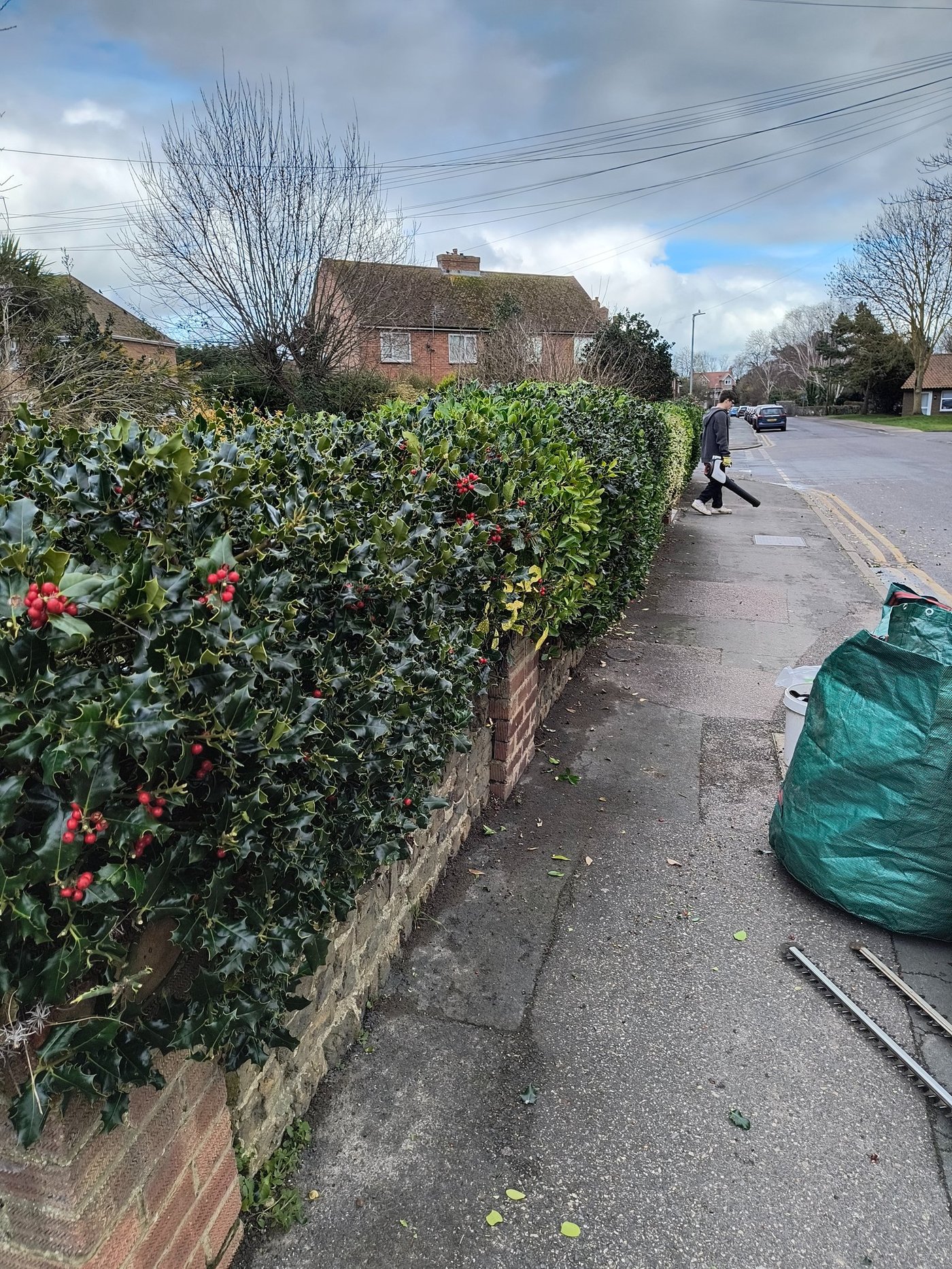
There's a reason you see privet down every street in Sandwich. It's tough as old boots, takes a hard cut, forgives a bad one, and fills in gaps without needing much from you. The trick's knowing what to do and when, and what to leave alone.
The annual rhythm
A healthy privet hedge wants a light trim around mid-June (once nesting's wound down for your particular hedge) and a proper cut in late August or early September. Two cuts, about twelve weeks apart. That's it.
If you only manage one cut a year, make it the August one. The hedge puts on new growth straight after, which "heals in" over autumn and gives you a crisp edge to look at all winter.
Check for nests first
Under the Wildlife and Countryside Act 1981, it's an offence to damage or destroy an active bird's nest. Nesting season runs roughly 1 March to 31 August, which is exactly why we say "once nesting's wound down" above rather than picking a fixed June date. If there's a nest in use, the cut waits.
The taper
Always trim the sides at a very slight angle, wider at the bottom than the top. Flat-sided hedges end up bare at the base because the top shades the bottom out. A 10-degree taper is plenty, you won't even see it, but the hedge will.
How hard can you cut?
Harder than you think. Privet's a rejuvenator, it'll resprout from bare wood if you need to take it back. If you've inherited a hedge that's 8 foot wide when it should be 3, you can cut it back to a stub in late winter and it'll come back. Not pretty for the first summer, but it will come back.
The usual reason for a hard cut-back is that someone's been "just trimming the tips" for years, and the hedge has crept outwards a metre or more. A single restoration cut in February or March resets it.
Feeding, watering, the bits nobody does
Privet doesn't need much. A handful of general-purpose fertiliser along the base in March is plenty. If your hedge is yellowing rather than green, that's usually a nitrogen hint, a mulch of well-rotted manure or a light nitrogen feed sorts it.
New hedges (under three years old) need watering in dry spells. Established ones can generally look after themselves, which is one of the reasons it's so popular.
Pests and problems
Privet's mostly trouble-free. The one to watch for is privet thrips, tiny insects that give leaves a silvery, slightly bruised look in mid-summer. Usually nothing serious. A hard cut and a feed tends to fix it. Honey fungus can take out old hedges, but that's rare.
When privet's not the answer
If you want glossy evergreen leaves through winter, privet's a bit thin. It's semi-evergreen, it'll drop some leaves in a hard frost. For denser winter cover, yew or holly are better shouts. But for fast, forgiving, cheap and tidy, privet wins every time.
A well-kept privet hedge will outlive you. Two cuts a year and the occasional feed is all it needs.
Rather not do it yourself?
We cut privet hedges across Sandwich, Deal and the villages every week. Send a photo and we'll send a fair quote.