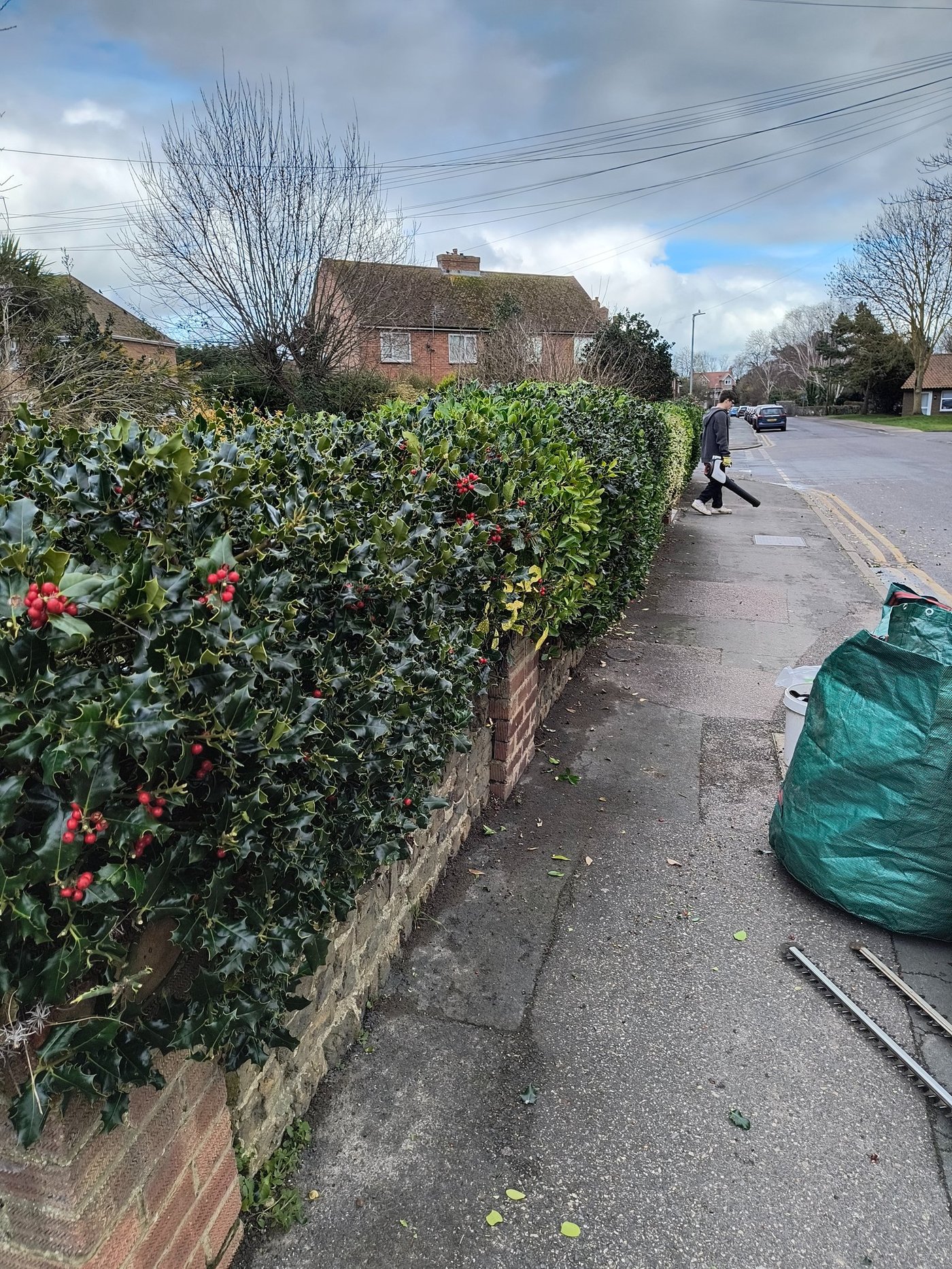
Cotoneaster is one of those plants that a lot of people have in their garden without being entirely sure what it is. It turns up in hedgerows, as wall-trained shrubs and as dense screening hedges. In Kent gardens it tends to be one of the first plants that actually produces something useful for garden birds, particularly fieldfares and redwings moving through in late autumn.
It is also, thankfully, a straightforward plant to manage. A light annual cut and it keeps its shape well. The mistake most people make is cutting it at the wrong time of year, which removes either the flowers or the berries before the birds get a look in.
Before you start: safety and the Wildlife and Countryside Act 1981
Cotoneaster's dense growth provides good nesting cover. Check for active nests before you trim between 1 March and 31 August. Damaging an active nest is an offence under the Wildlife and Countryside Act 1981. The safe cutting window is September to February, which conveniently aligns with the end of berry season for most varieties. For more detail on the law and practical checks, see our wildlife-friendly trimming guide.
Safety equipment: eye protection and sturdy gloves. For taller hedges, use a long-reach pole trimmer rather than a ladder. If a ladder is unavoidable, have someone footing it. Use an RCD adaptor if trimming with a corded electric trimmer.
Which cotoneaster do you have?
The main hedging varieties in Kent gardens:
Cotoneaster franchetii (Franchet's cotoneaster)
A semi-evergreen, arching shrub with sage-green leaves and small white-pink flowers in June, followed by orange-red berries. Good for an informal hedge or screen up to about 2.5 metres. One of the most common varieties you will find in East Kent gardens. Prune in late winter (February) or immediately after flowering.
Cotoneaster lacteus (late cotoneaster)
A reliable evergreen with large, leathery, dark green leaves and heavy crops of red berries that last from October right through to March. Better for a taller privacy hedge, up to 3 metres or more. Less commonly planted than franchetii but very good for sustained winter berry colour. Prune in late winter.
Cotoneaster simonsii
Semi-evergreen, more upright in habit, often used in mixed country hedges alongside hawthorn and blackthorn. Produces good crops of berries. Deciduous in cold winters, semi-evergreen in mild ones (East Kent's coastal climate is mild enough that it usually keeps a good proportion of its leaves through winter). Prune in late winter while dormant.
A note on invasive species
Cotoneaster horizontalis (wall cotoneaster) and a handful of other species are listed on Schedule 9 of the Wildlife and Countryside Act 1981 as invasive non-native plants in England. It is an offence to plant them in the wild or allow them to spread into the countryside. Do not use these species for new hedging near open land, roadsides or waterways. The varieties above (franchetii, lacteus, simonsii) are not on Schedule 9 and are suitable for garden hedging. If you are unsure which variety you have, check before buying or propagating.
When and how to prune cotoneaster
Step 1: Choose your timing
For evergreen varieties: prune in late February or early March, before the new growth starts. This is after the birds have finished with the berries (usually) and before the flowers open in May. You get berries in autumn, flowers in spring, and the cut comes in between them. For deciduous or semi-evergreen types: late winter while dormant, same window.
Step 2: Assess the hedge
Before you pick up a tool, look at the hedge and decide what it needs. A cotoneaster hedge that was trimmed last year probably needs only a light shaping cut: taking off new extension growth and tidying the outline. One that has not been cut in several years may need more significant reduction. Plan the cut before you start so you do not take off more than you intended.
Step 3: Remove dead, damaged or diseased wood first
Cotoneaster is susceptible to fireblight (Erwinia amylovora), a bacterial disease that causes shoots to die back suddenly, as if scorched. If you see this, cut the affected branch back to healthy wood well below the damage. Sterilise your tools between cuts with a dilute bleach solution or surgical spirit. Do not compost affected material; bin it.
Step 4: Shape the hedge
For a formal, clipped hedge: a hedge trimmer is the right tool and it handles cotoneaster well. Cut the top flat and taper the sides slightly (wider at the base than the top lets light reach the lower stems). For a more natural, arching shape: hand shears or secateurs give a cleaner result and avoid the shredded-leaf look you can get from a fast-spinning trimmer blade on larger leaves. The Royal Horticultural Society's YouTube channel (The RHS, over 100,000 subscribers) covers cotoneaster care and pruning as part of their hedge guidance, which is a useful visual reference for technique. Find their channel at youtube.com/@The_RHS.
Step 5: Clear the clippings
A tarpaulin at the base of the hedge makes clean-up much faster. Rake out any clippings that fell into the hedge interior, as they can create damp conditions that encourage disease. See our guide on what to do with hedge trimmings for the best disposal options.
Step 6: Mulch if needed
After pruning is a good moment to spread a mulch of compost or bark around the base of the hedge, keeping it a few centimetres clear of the stems. This helps moisture retention through summer and suppresses weeds. It also feeds the hedge slowly without producing the fast, soft growth that a direct fertiliser application can. See our guide to feeding and fertilising hedges for the detail on nutrients and timing.
Is a light summer tidy ever needed?
For a very formal clipped shape, yes, a light trim in June or July can tighten the outline. Do not trim if there are active nests and do not cut heavily enough to remove the developing berries. A light pass with hand shears to tidy stray shoots is fine; a full clip back is not.
Wildlife value
Cotoneaster is outstanding for wildlife. The flowers are a reliable early-summer nectar source for bees. The berries are eaten by a long list of birds: song thrushes, mistle thrushes, blackbirds, starlings, fieldfares and redwings all come for them. In East Kent, fieldfares and redwings are reliable autumn visitors along the coastal strip from Sandwich Bay down to Deal, and a well-berried cotoneaster hedge will bring them into the garden.
The dense structure also provides good nesting sites for robin, dunnock and blackbird. All of which means you should be careful and thorough with your nest check before any summer trim.
Cotoneaster on boundary hedges
Cotoneaster's arching habit means it can spread outwards quite quickly. On a boundary adjacent to a pavement or a neighbour's property, check the spread each spring and trim back overhanging growth before it becomes a problem. For guidance on what you can and cannot cut back on a boundary hedge, see our guide to hedge heights and the High Hedges Act.
Need a hand with a cotoneaster that has got out of hand?
We work across Sandwich, Deal, Worth, Ash, Woodnesborough, Eastry and Sandwich Bay. Overgrown cotoneaster responds well to professional renovation. Send us a photo for a free quote.