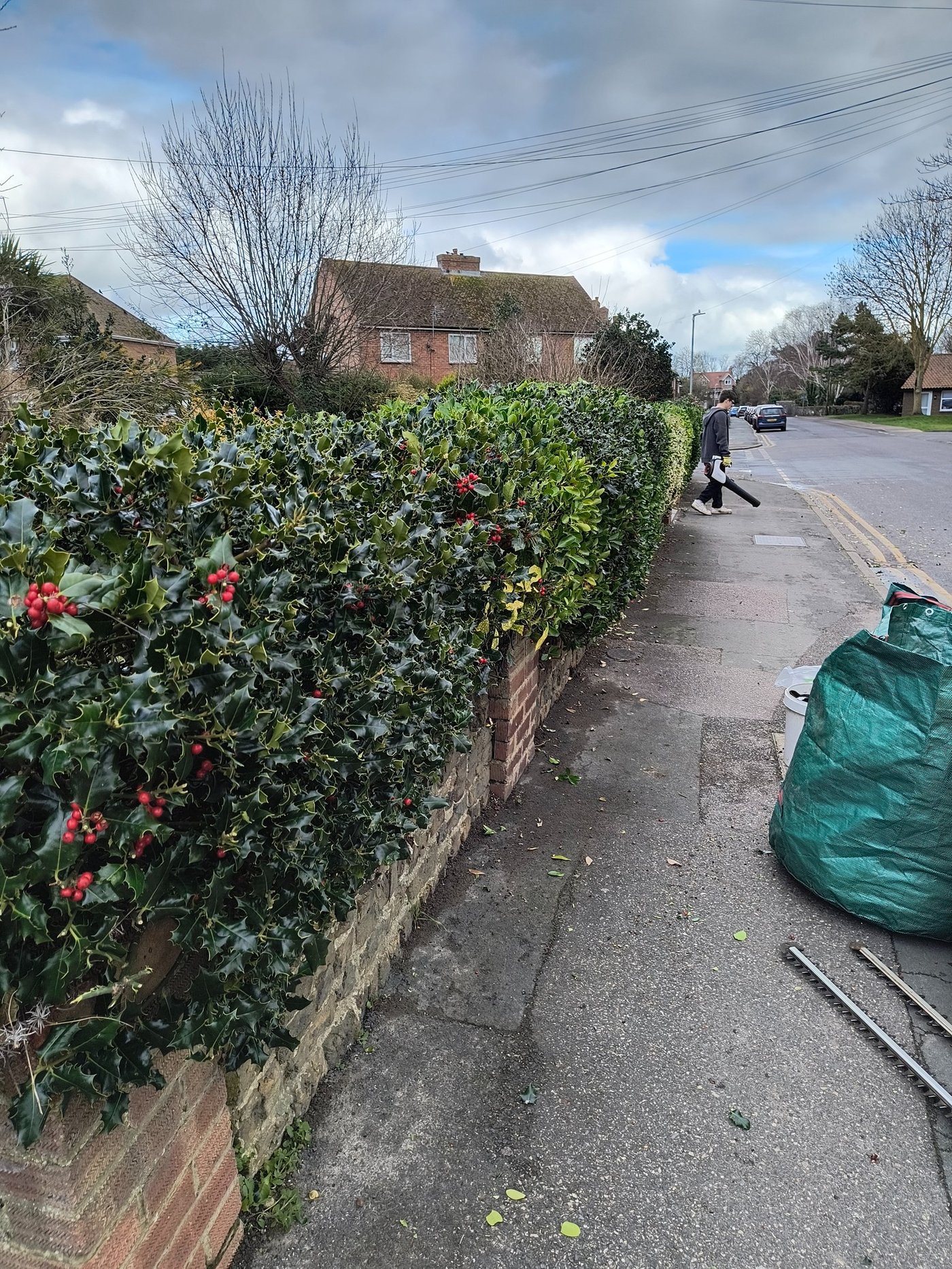
Fences stop you seeing the road. A good hedge absorbs the sound. That distinction matters more than most people realise until they have both.
A solid fence reflects sound: the noise bounces off the boards and can even intensify at certain angles. A dense hedge, particularly an evergreen one, absorbs and scatters sound through its leaves, stems and the air pockets inside the mass. Research from the RHS and acoustic engineers consistently puts a well-maintained 2 m evergreen hedge at 4-6 dB of noise reduction, which is roughly a halving of perceived loudness. Fences achieve 3-4 dB at similar heights and far less if there are gaps at the base.
The effect is cumulative with depth. A hedge 1 m deep absorbs noticeably more than a clipped 20 cm flat surface. That is one reason why slightly informal evergreens often outperform their tightly clipped equivalents: they hold more mass.
How hedges outperform fences for noise
Three things drive a hedge's noise-absorbing performance: leaf area, stem density, and year-round coverage.
- Leaf area: large, overlapping leaves (cherry laurel, Portugal laurel) create more surface for sound to hit and scatter than small-leaved species like privet or box.
- Stem density: species that branch densely from the base (hornbeam, beech, hawthorn) leave fewer gaps at ground level where noise travels.
- Year-round coverage: deciduous hedges lose most of their acoustic value in winter, the months when road noise feels most intrusive. Evergreens maintain the barrier throughout the year.
Five species compared for noise reduction
These are the species we most commonly see along Kent roads and boundaries. All are suitable for East Kent's climate and soils.
| Species | Leaf size | Evergreen? | Growth rate | Noise performance |
|---|---|---|---|---|
| Cherry laurel | Large | Yes | Fast (40-60 cm/yr) | Excellent |
| Portugal laurel | Medium-large | Yes | Medium (20-30 cm/yr) | Very good |
| Leylandii | Fine/feathery | Yes | Very fast (60-90 cm/yr) | Good (depth matters) |
| Hornbeam | Small-medium | No (holds dead leaves) | Medium (20-40 cm/yr) | Good (winter: moderate) |
| Privet | Small | Semi (loses some in hard winters) | Fast (30-45 cm/yr) | Moderate |
The verdict: when to choose which
Cherry laurel: the workhorse choice
For noise reduction alongside a busy road or railway boundary in East Kent, cherry laurel gives the most acoustic mass for the least wait. It establishes quickly on clay and loam soils, handles salt wind reasonably well, and its large leaves are highly effective at scattering sound. The main caveat is scale: it needs space. Allow 1.5-2 m of depth at minimum. On a narrow plot, Portugal laurel is a better-behaved alternative.
Portugal laurel: slower but more manageable
Portugal laurel takes to formal clipping better than cherry laurel and stays at a manageable height without constant attention. At 2 m, a well-established Portugal laurel hedge reduces noise noticeably. It handles coastal winds and thin chalk soils around Sandwich Bay and Eastry better than cherry laurel. The downside is patience: allow four to five years to build useful mass from young plants.
Leylandii: quick but depends on depth
Leylandii gets a bad reputation from boundary disputes, but as a noise screen it has real advantages: it establishes within two to three years, can be kept at 2-3 m with proper management, and forms a dense wall of foliage year-round. The fine, feathery foliage is less acoustically efficient per cm of depth than broad-leaved evergreens, so allow extra depth if the noise source is close. See our guide on managing leylandii height and neighbour law.
Hornbeam: the deciduous option that still works in winter
Hornbeam holds its dead brown leaves through winter, which gives it more acoustic value than other deciduous species in the cold months. It is a good choice where an informal, slightly naturalistic look is preferred: it is also excellent for wildlife, providing nesting sites and seed for finches. It is not a replacement for a true evergreen on a very busy road, but on a rural lane near Worth or Ash it is often entirely adequate and better for the local ecology.
Height and depth: the two things that matter most
Whatever species you choose, two variables drive performance more than any other:
- Height: noise travels in a line from source to listener. A hedge needs to be taller than the source (or at least at the same height as the road surface and vehicles) to intercept it. For most residential situations alongside a road, 2 m is the minimum useful height. 2.5-3 m is noticeably better. Be aware of the High Hedges legislation (Anti-social Behaviour Act 2003, Part 8) if the hedge is on a shared boundary: see our guide on hedge heights and neighbour law.
- Depth: mass equals absorption. A hedge 80 cm deep is not the same as a hedge 1.5 m deep, even at identical height. Where space allows, let the hedge grow with some depth rather than clipping it very flat.
Planting for maximum effect
Plant in a double, staggered row rather than a single line where space allows: two rows 45-60 cm apart, with plants offset between rows, gives you double the depth without double the waiting time. Space individual plants 60-75 cm apart within each row for species like cherry and Portugal laurel, and 50-60 cm for privet and hornbeam.
On the roadside boundary itself: plant bare-root hedging in October to February for best establishment (see our guide on planting bare-root hedges). Water in the first summer and mulch heavily around the root zone. On Kent's clay soils, the hedge will mostly look after itself by year three.
Video: Hedges to help the environment | Greening Great Britain from the Royal Horticultural Society. Covers the environmental and acoustic benefits of garden hedgerows in the UK.
Want a noise barrier planted properly?
We plant and establish hedges across Sandwich, Deal, Worth, Ash, Woodnesborough, Eastry and Sandwich Bay. Send a photo or a sketch of the boundary and we'll advise on species and spacing for your specific situation.