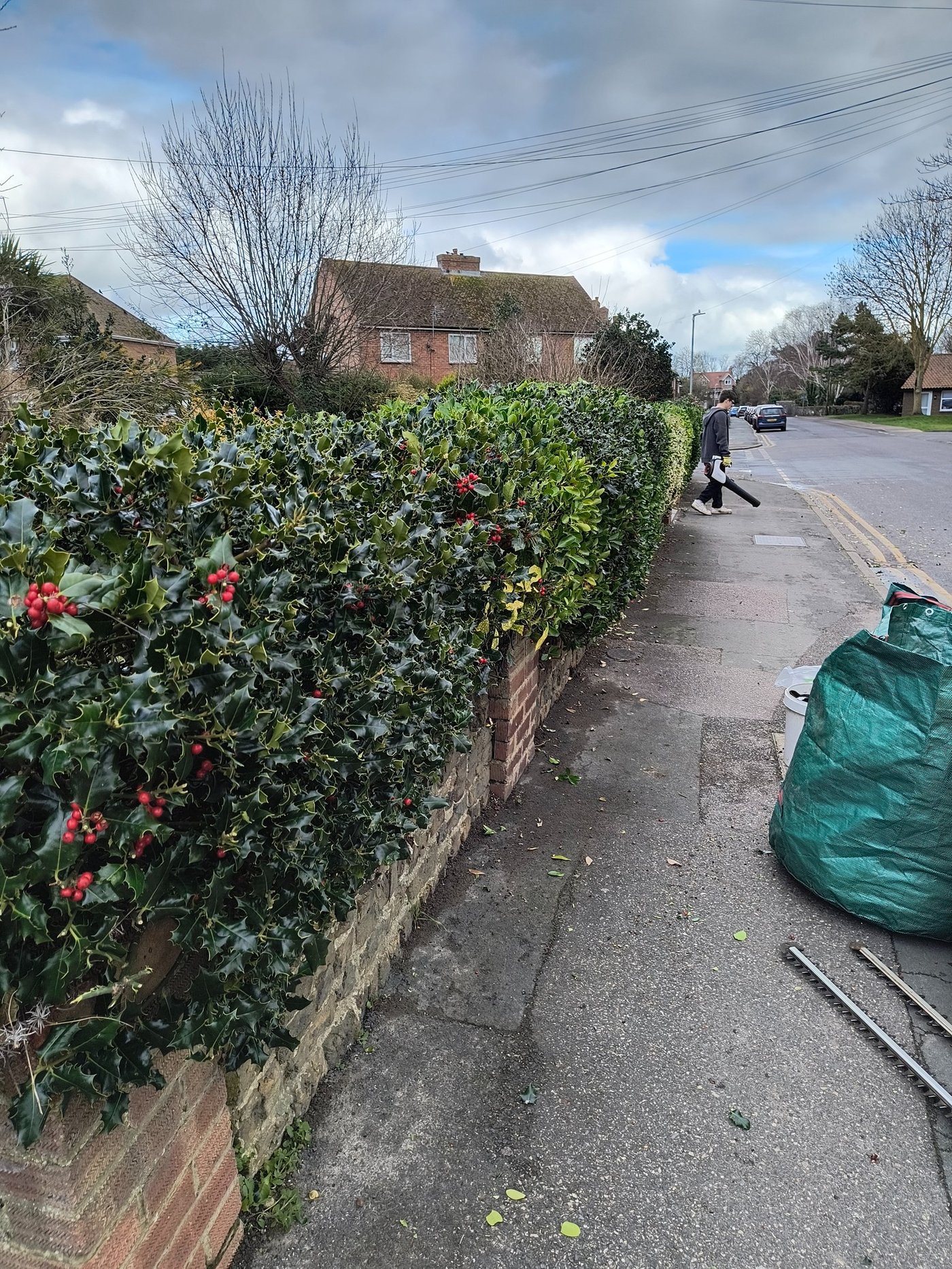
Over the past decade, box hedges across East Kent have suffered significant losses to box blight (Cylindrocladium buxicola) and, more recently, box tree moth caterpillar (Cydalima perspectalis). Both problems have been particularly noticeable in the humid coastal conditions around Sandwich, Deal and Sandwich Bay, where fungal disease spreads readily and the moth is now well established.
The result is that many gardeners are replacing box or looking for an alternative before the problem arrives. Among the realistic substitutes, Ilex crenata (Japanese holly) stands out as the closest visual match and the easiest to manage. Lee Burkhill of the Garden Ninja YouTube channel (over 78,000 subscribers, BBC Garden Rescue presenter) covers box blight and alternatives in detail on his channel, including practical comparisons for UK garden conditions.
This guide covers how to plant, shape and maintain Ilex crenata in East Kent, including what to do on the chalk soils around Sandwich and Woodnesborough.
Why Ilex crenata?
Ilex crenata is a slow-growing evergreen shrub with small, rounded, dark green leaves that closely resemble Buxus sempervirens. It holds topiary shapes well, responds to hand shears and a powered trimmer, and maintains dense growth without excessive feeding. Crucially, it has no susceptibility to box blight or box tree moth caterpillar, which are host-specific to Buxus.
Growth rate is slightly slower than box, which for most formal applications is not a drawback: it means fewer cuts per year and a shape that stays sharp longer. Available cultivars include 'Convexa' (rounded, dense, most common), 'Dark Green' (upright habit, useful for low formal hedges) and 'Green Hedge' (slightly faster, good for screening).
Before you start: what to check
Ilex crenata does best on slightly acidic to neutral soil (pH 5.5 to 7.0). East Kent's chalk soils tend to run alkaline (pH 7.5 or above), which can cause yellowing leaves (chlorosis) and slow establishment. Test your soil pH before planting and be prepared to modify the soil. Also check sun exposure: Ilex crenata tolerates partial shade but performs best in sun or light shade.
Step 1: soil preparation
On chalk or thin limestone soil, dig out the planting area to a spade's depth and mix in generous amounts of acidic compost (ericaceous compost or well-rotted leaf mould) at roughly a third of the backfill by volume. This lowers local pH around the root zone. You cannot fully neutralise chalk in the long term, but creating an improved root environment gives plants a good start and slows the reversion. On free-draining sandy loam (common around Eastry and Ash), standard compost improves water retention without any pH concern.
Step 2: planting
Plant at 3 to 5 plants per metre for a formal hedge below 60cm, or 2 to 3 plants per metre for a hedge up to 1 metre. Pot-grown stock is available year-round. Plant at the same depth as the pot, firm in well, and water thoroughly. Keep plants consistently moist for the first season.
Spring planting (March to May) or early autumn planting (September to October) are both good times. Avoid planting in high summer heat. See our hedge planting spacing guide for a full spacing table and our spring planting guide for first-year watering advice.
Step 3: watering in the first year
Ilex crenata is not drought-tolerant when young. Water every two to three days for the first six to eight weeks after planting, then regularly through the first summer. This is the single most important factor in establishment. A seep hose along the planting line makes consistent watering much easier on a long run.
On chalk soils, water with collected rainwater rather than mains water where possible. Mains water in East Kent is hard and slightly alkaline; rainwater is naturally slightly acidic and a better match for what Ilex crenata prefers.
Step 4: mulching
Apply a bark mulch 75mm deep along the full planting strip immediately after planting. Use an acidic bark mulch (pine bark or composted bark from conifers) rather than a mushroom compost, which raises pH. Keep mulch away from the plant stems. Refresh annually. This step makes a significant difference on chalk and sandy soils, retaining moisture and slowly improving soil structure.
Step 5: feeding
In the second and third years, feed with an ericaceous fertiliser (specifically formulated for acid-loving plants) in early spring. This provides trace elements including iron and manganese, which become unavailable to plants in high-pH soils. A single application of a slow-release ericaceous feed each spring is sufficient; over-feeding causes soft, sappy growth that shears poorly.
Step 6: trimming and shaping
Ilex crenata grows more slowly than box and typically needs cutting once or at most twice a year. For a formal low hedge, trim in late May or early June and again lightly in August or early September. For topiary shapes, use hand shears for precision: the plant clips cleanly and the small leaves do not shred in the way some species do.
The nesting season constraint applies just as it does to any hedge. See the nesting note below.
When shaping from a young plant, remove no more than a third of the growth at any cut. Build the shape gradually over two to three years; Ilex crenata recovers slowly from very hard cuts compared to its faster-growing counterparts.
Step 7: troubleshooting
Yellow leaves. The most common problem on East Kent chalk soils. Chlorosis (iron deficiency caused by high pH) shows as yellowing between leaf veins, with veins remaining green. Apply chelated iron (sequestrene) and review soil pH. Switching to rainwater for irrigation helps in the medium term.
Slow establishment. Normal for this species in its first two years. Ilex crenata is not a fast grower and patience is required. Do not overfeed in an attempt to accelerate growth; you will get fewer cuts per year as a result, which for a formal hedge is the goal.
Leaf scorch. Coastal winds can cause leaf browning on exposed East Kent sites (Sandwich Bay in particular). A temporary windbreak or sheltered planting position helps in the first year while roots establish.
Nesting season: applies to trimming, not just cutting
The Wildlife and Countryside Act 1981 makes it an offence to damage or destroy an active bird's nest. Nesting season runs from 1 March to 31 August. Ilex crenata is trimmed in late May to June and/or August. For the late May to June trim, check the hedge thoroughly before cutting. Even a small formal hedge in a front garden can host a wren or robin nest. If you find a nest, delay trimming that section until the birds have fledged (typically two to three weeks). The August cut, if after the 1st, is within the safe window for most species, but a quick visual check remains good practice. See our wildlife-friendly trimming guide.
Replacing a box hedge with Ilex crenata?
We carry out box hedge removal and new hedge installation across Sandwich, Deal, Worth, Ash, Woodnesborough, Eastry and Sandwich Bay. Send us a message for a free quote and species advice for your specific garden.
Related guides
Box hedge alternatives: six plants that won't get box blight
A broader look at six species that can replace Buxus, including Ilex crenata, Lonicera nitida, Euonymus and others.
Read the guide SpeciesBox blight treatment
How to identify box blight, slow its spread, and decide whether to treat or replace the affected hedge.
Read the guide