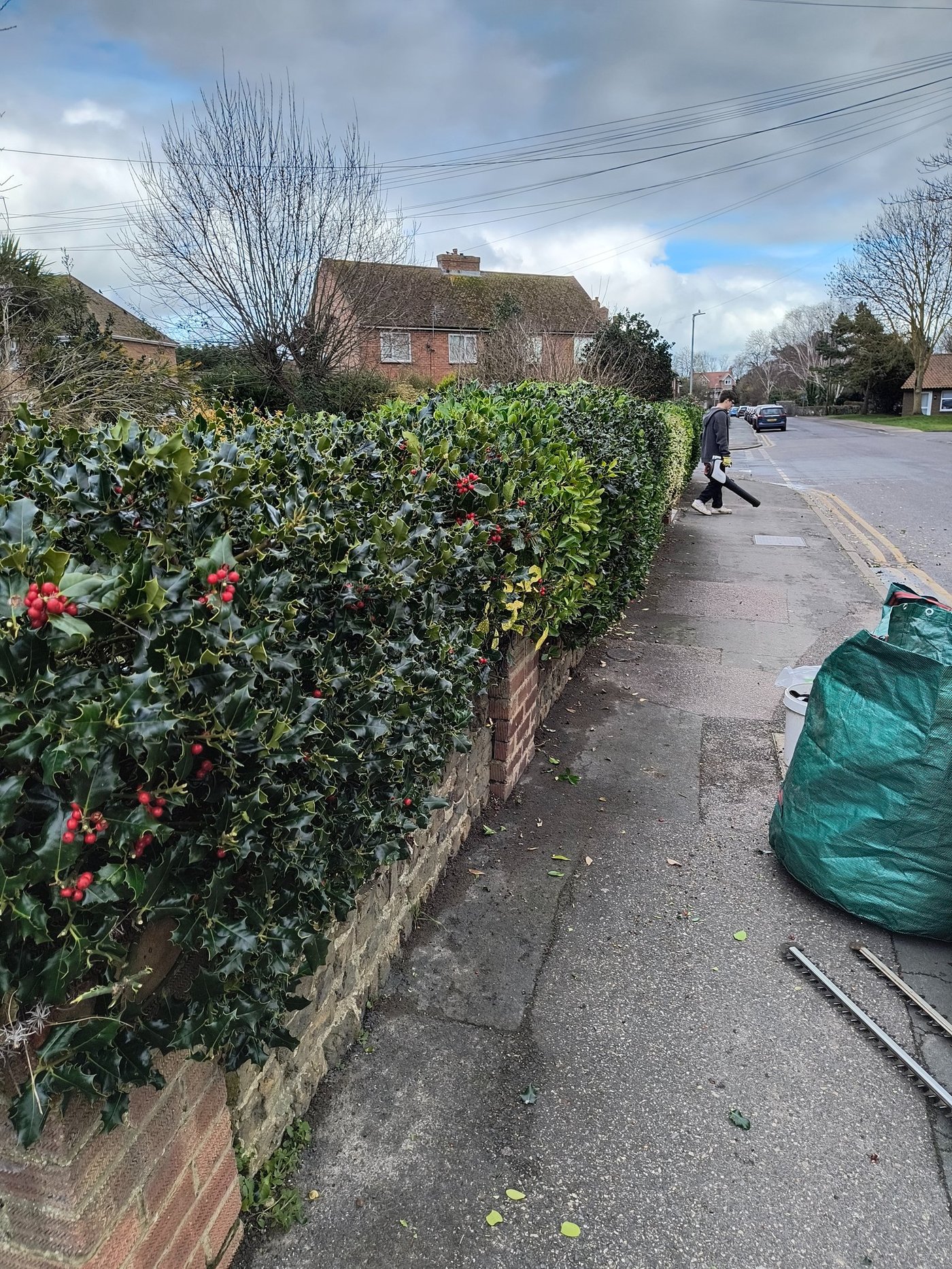
Box has been the defining plant of formal English gardens for centuries. It is slow-growing, extraordinarily dense, and tolerant of hard cutting in a way that few hedging plants match. The small, glossy leaves give a clean finish that yew and privet can only approximate.
The downside: box blight and box tree moth have made it much harder to keep a box hedge looking healthy than it was twenty years ago. Neither is a reason to rip the hedge out, but both need a bit of thought. Here is what we actually do when maintaining box hedges in East Kent gardens.
Nesting season
The UK Wildlife and Countryside Act 1981 makes it an offence to damage or destroy an active bird's nest. Nesting season runs roughly 1 March to 31 August. Both main box trimming windows (late May and late August) fall within or on the edge of this period. Always check the hedge is demonstrably empty before you start. The safe all-clear window for most hedges is September to February. See our full guide to when to trim hedges in Kent for the month-by-month picture.
Before you start
- Eye protection: flying box clippings are small and sharp. Wear safety glasses or goggles.
- Gloves: sturdy work gloves protect from blisters and any embedded wire in older hedges.
- Electric trimmers and RCDs: if using a corded trimmer, always plug in via a residual current device (RCD). Trail the cable away from your working direction so you cannot cut through it.
- Ladders: for box hedges over roughly 1.2m, a pole trimmer or long-reach shears keeps you on the ground. If you must use a ladder, have someone footing it and never overreach sideways.
- Wasp nests and brambles: box hedges can conceal both. Part the foliage from the outside first and look in before you start.
- Tool hygiene: because of box blight, sterilise your shears or trimmer blades before you start and between plants with diluted bleach (one part household bleach to nine parts water) or 70% isopropyl alcohol.
The trimming calendar
Late May to early June: the main cut
Box puts on a flush of soft new growth in spring. Once that growth has hardened slightly, usually around late May or the start of June, it is ready for its main annual cut. Clip back to the established shape, or a little tighter if you want to compact the hedge over time.
This cut falls within nesting season, so check the hedge is empty first. Low box edging hedges, the type that borders a path or flower bed, rarely have active nests in them. Taller box hedges (over about 60cm) need a proper look before you start.
Late August: the second tidy
Box grows again through summer. A second light trim in late August keeps the edges crisp and removes the summer extension before it gets too long. Do not cut hard at this point, just take the soft tips back. This cut is also on the edge of nesting season; late August is when most broods have fledged, but pigeons in particular nest late, so check first.
September to February: the safe window
If you only want to trim once and you are happy for the hedge to look a little loose through summer, cut in September. Outside the nesting season, there is no legal risk and you can be as thorough as the hedge needs.
What tools to use
Hand shears are the traditional tool for box and, for topiary balls, spirals and intricate shapes, they still give the best control. The small, precise blades let you work into angles that a powered trimmer cannot reach.
For a long run of flat-topped box edging, a small cordless trimmer or electric trimmer speeds things up considerably. Box leaves are small enough that the cut surface looks fine after trimming, unlike cherry laurel where the cut leaves show as brown patches. Keep the blades sharp: blunt trimmer blades bruise rather than cut and make the hedge look worse, not better.
Single-action topiary shears are worth buying if you maintain box balls. They are lighter and more precise than standard shears and make the difference between a rough approximation and a genuinely clean sphere.
Box blight: the main thing to know
Box blight is caused by two fungal pathogens (Cylindrocladium buxicola and Pseudonectria buxi). It has been present in UK gardens since the late 1990s and is now widespread. In a wet summer in East Kent, a box hedge that looked fine in spring can develop significant patches of browning by July.
What to look for: straw-coloured or brown patches spreading through the foliage, with black streaking on young stems. Leaves fall, leaving bare patches. Spores spread by rain splash and on contaminated tools.
What helps:
- Only trim when the foliage is dry. This is the single most important rule. Trimming in wet conditions spreads spores from plant to plant via the blades and through rain splash.
- Sterilise your blades before and between plants. Use diluted bleach or 70% isopropyl alcohol, wiping the blades clean rather than just spraying and leaving.
- Remove fallen leaves and debris from around the base of the hedge. The fungus overwinters in leaf litter.
- Improve air circulation where the hedge is dense or planted close to walls. Blight is worst in humid, sheltered spots.
- Fungicide treatments exist but need multiple applications through the season; they suppress rather than cure. If a section is badly affected, cutting it out cleanly, sterilising the tools, and removing all debris gives better results than repeated spraying.
Box tree moth
Box tree moth (Cydalima perspectalis) is a separate problem from blight, and increasingly common across Kent. The caterpillars eat the foliage from within the hedge, leaving behind fine webbing and green droppings. A bad infestation can strip a box hedge to bare stems within a few weeks.
We have a separate guide covering how to identify box tree moth damage, when the moth flies, and what the management options are: box tree moth caterpillar damage.
Renovation: bringing an overgrown box hedge back
Box tolerates very hard cuts. If the hedge has spread considerably wider than you want, or has become leggy, you can cut back to the bare wood in late February or early March, before the spring growth flush and before nesting season.
Cut back to within 15-20cm of the desired final size. Box will break new shoots from old wood, usually within the same growing season. Give the base a balanced slow-release fertiliser and water during dry spells to support recovery. Do not try to restore the full shape in a single season: trim the new growth lightly in August to thicken it, then bring it to the finished outline the following spring.
In Kent's mild coastal climate, box recovers well from renovation cuts. We have done hard cuts on box hedges in gardens across Sandwich, Deal and Worth in late winter, and by September the hedges are putting on enough new growth to be shaped again.
Trim box in dry weather, sterilise your blades, and don't skip the second cut in August. Those three habits make the difference between a box hedge that looks sharp all year and one that gradually goes wrong.
Credit: the best4hedging channel's video "A focus on Box hedging: All you need to know about Buxus Sempervirens" is a useful introduction to the species from one of the UK's leading specialist hedging nurseries. You can find it on YouTube by searching for that title or the channel name.
Rather we handled it?
We trim box hedges and topiary across Sandwich, Deal, Worth, Ash, Woodnesborough, Eastry and Sandwich Bay. Send a photo for a free quote, most gardens booked the same week.