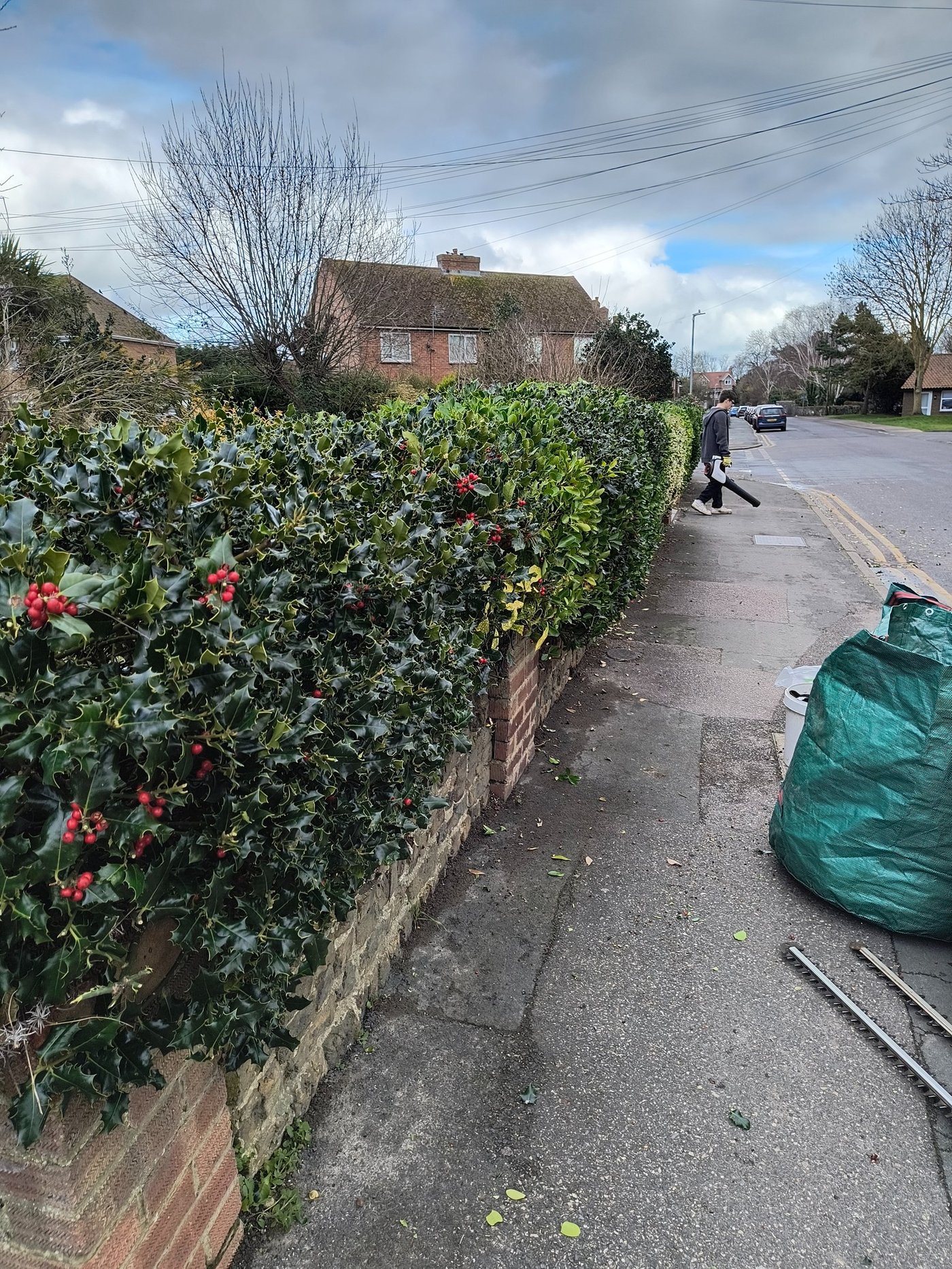
We plant a lot of security hedges across East Kent. The requests usually come from one of three places: someone who has had a trespass problem, someone who wants to replace a failing fence on a field boundary, or someone who wants to screen the garden from a road without a solid wall. Thorny hedges serve all three purposes, and for a boundary hedge in particular they outlast fencing and improve with age.
The five species most worth considering for security in Kent are hawthorn, blackthorn, pyracantha, berberis and holly. Each has a different character: some are native, some evergreen, some faster. The comparison below covers what actually matters when making the choice.
Gardening With Alan Titchmarsh covers pruning and maintenance of several of these species in his YouTube series on shrubs and hedging: Prune these plants NOW before it is too late (Gardening With Alan Titchmarsh, YouTube). The channel has 185,000 subscribers and covers practical UK gardening in detail.
Species comparison
| Hawthorn | Blackthorn | Pyracantha | Berberis | Holly | |
|---|---|---|---|---|---|
| Evergreen | No | No | Yes | Yes (most) | Yes |
| Thorn type | Sharp spurs, dense | Long, very sharp spines | Sharp spines along stems | Fine, three-pronged spines | Leaf spines, no stem thorns |
| Growth rate | Fast: 40-60cm/year | Fast: 40-60cm/year | Medium: 20-30cm/year | Slow-medium: 15-25cm/year | Slow: 15-25cm/year |
| Max height | 3m+ as hedge, much taller uncut | 3m+ as hedge | Up to 3m | 1-2m depending on variety | 3m+ if allowed |
| Trimming | Once or twice, July-Aug or winter | Once, July-Aug or winter | Once, after flowering (May-June) | After flowering or late summer | Once, late summer |
| Wildlife value | Excellent: flowers, berries, nesting | Excellent: sloes, nesting | Good: berries for birds | Good: flowers for pollinators | Good: berries for thrushes |
| Native to Kent | Yes | Yes | No (Asia) | Partly | Yes |
| Bare-root available | Yes, Oct-March | Yes, Oct-March | Pot-grown only | Usually pot-grown | Yes, Oct-March |
Nesting season applies to all five species
Hawthorn, blackthorn, pyracantha, berberis and holly are all used as nesting sites by garden birds. The nesting season runs 1 March to 31 August. Trimming any of these species during this period without checking first for active nests risks committing an offence under the Wildlife and Countryside Act 1981. The safe cutting window is late July or August once nesting has wound down, through to the following February. Never cut before checking.
Hawthorn (Crataegus monogyna)
Hawthorn is the traditional field boundary hedge of Kent and for good reason. It grows fast from cheap bare-root whips, takes hard pruning well, and after five or six years of regular trimming produces a base so dense and thorny that it is genuinely stockproof. The thorns are short but numerous, grouped in clusters along every stem. Trying to push through an established hawthorn hedge is painful; trying to do it quickly is almost impossible.
For boundary hedging in East Kent, hawthorn is our default recommendation. On the chalk soils around Sandwich, Kingsdown and the North Downs villages it establishes readily. On heavier clay ground around Worth and Ash it grows well too, though slightly less vigorously than on free-draining soil. Bare-root whips are available in volume from October and are the most economical way to plant a long boundary.
The main limitation is that hawthorn is deciduous: in winter the stems are visible, and a hedge that has not been allowed to bulk up sufficiently will have gaps at the base. A newly planted hedge will not be stockproof in year one. Allow four to five years for a properly stockproof barrier.
See our hawthorn hedge care guide for detail on trimming schedule and renovation.
Blackthorn (Prunus spinosa)
Blackthorn has longer, sharper spines than hawthorn, and in some ways is the more formidable security plant. It flowers on bare wood in early spring (the white blossom before the leaves appears in February and March), then produces sloes in autumn. It suckers freely, which means it will spread outward if not managed, but also means it fills gaps in a hedge without replanting.
Blackthorn tolerates the coastal conditions around Sandwich Bay and the Deal seafront better than most species: the thick-stemmed, deep-rooted nature of a mature blackthorn stands up to salt wind. It is equally common as field boundary hedging across the inland parishes of Eastry and Woodnesborough.
The suckering habit means blackthorn needs annual attention on its sides and base to prevent it spreading into adjoining land. This is not a low-maintenance choice, but it is a highly effective one. A blackthorn and hawthorn mixed hedge is one of the most widely planted native security combinations in East Kent.
Pyracantha (firethorn)
Pyracantha is the most popular evergreen security hedge species in Kent gardens. It produces white flowers in May and June (attractive to bees and hoverflies), then heavy clusters of orange, red or yellow berries that last well into winter and are eaten by thrushes and blackbirds. The spines are sharp enough to deter most people from attempting to push through a well-grown specimen.
The main advantage over hawthorn and blackthorn is the year-round leaf cover: a pyracantha hedge provides visual screening and physical deterrence in January as well as July. It also clips into a tighter, more formal shape than the native species, which makes it a reasonable choice for smaller town gardens in Sandwich or Deal where a formal boundary is preferred.
The main limitations are: slower establishment than hawthorn or blackthorn, higher initial cost (pot-grown only, no bare-root equivalent), and susceptibility to fireblight (a bacterial disease that causes the branch tips to die back). It also needs trimming with care as cutting into the flower buds reduces the following year's berry crop. Cut after flowering in June rather than in late summer if berry production matters.
Berberis
Berberis (barberry) is used for security hedging mainly in urban gardens where height is limited and a tidier, more ornamental appearance is wanted. The spines are fine, three-pronged, and extremely sharp: even brief contact with a berberis hedge is uncomfortable. Most cultivars are evergreen or semi-evergreen. The yellow or orange flowers in spring are attractive to bees.
The downside for boundary security use is ultimate height: most berberis cultivars used as hedges reach 1-1.5m. That is enough for a deterrent at knee height but not enough to provide real screening or to prevent climbing. For a road-boundary or garden-edge deterrent rather than a stockproof boundary, berberis is effective; for a full boundary security hedge, hawthorn or blackthorn is a better choice.
For detail see our berberis hedge care guide.
Holly (Ilex aquifolium)
Holly is the most slowly establishing of the five species but produces the most formidable mature hedge. The leaf spines are rigid and very sharp, and a dense holly hedge is effectively impenetrable. Holly is also evergreen, so it provides year-round screening as well as a year-round physical barrier. The berries are a significant food source for mistle thrushes and fieldfares in winter.
The limitation is time. Holly is slower than hawthorn, blackthorn or pyracantha, and a newly planted holly hedge will take six to eight years to provide serious deterrence. Bare-root holly is available and is significantly cheaper than pot-grown, but the plants establish more slowly than hawthorn. Holly is best used either where a very long-term hedge is being planned, or mixed with faster-establishing species to provide early bulk while the holly catches up.
Holly tolerates chalk, which makes it a reasonable choice on the well-drained soils of the North Downs and around Sandwich. See our holly hedge care guide.
A note on boundary law
There is no law against planting a thorny hedge on your boundary. However, any hedge on or near a boundary can become a dispute issue if it grows to block light or overhang a neighbour's property. Part 8 of the Anti-social Behaviour Act 2003 (the high hedges legislation) applies specifically to evergreen or semi-evergreen hedges over 2m that block light: pyracantha, berberis and holly can potentially be subject to a high hedges complaint; hawthorn and blackthorn (being deciduous) generally cannot. Keep all species trimmed to an agreed height. See our guide to hedge height and neighbour law for the full picture.
Which species for your situation
A few quick rules of thumb:
- Rural boundary or field edge: hawthorn, or hawthorn and blackthorn mixed. Fast, cheap, stockproof, excellent for wildlife.
- Garden boundary wanting year-round screening: pyracantha, or a mixed holly and hawthorn hedge. Pyracantha establishes faster; holly is more formidable once established.
- Coastal site (Sandwich Bay, Deal seafront): blackthorn or hawthorn. Both tolerate salt wind better than pyracantha.
- Town garden, smaller scale: pyracantha or berberis. Both clip neatly and provide deterrence without the vigour of hawthorn in a tight space.
- Chalk soil: hawthorn, holly, or pyracantha. Blackthorn is also fine on chalk. Berberis is usually chalk-tolerant too.
Planting a security hedge in Kent?
We advise on species, supply bare-root plants and plant to the correct density for your boundary. We cover Sandwich, Deal, Worth, Ash, Woodnesborough, Eastry and Sandwich Bay. Get a free recommendation and quote.
Related guides
Hawthorn hedge care in Kent
Trimming schedule, renovation, nesting-season timing and the two-cut system for hawthorn in East Kent gardens and field boundaries.
Read the guide SpeciesChoosing a hedge species for Kent gardens
Coastal, clay, chalk or shaded: a guide to matching species to site conditions across East Kent.
Read the guide