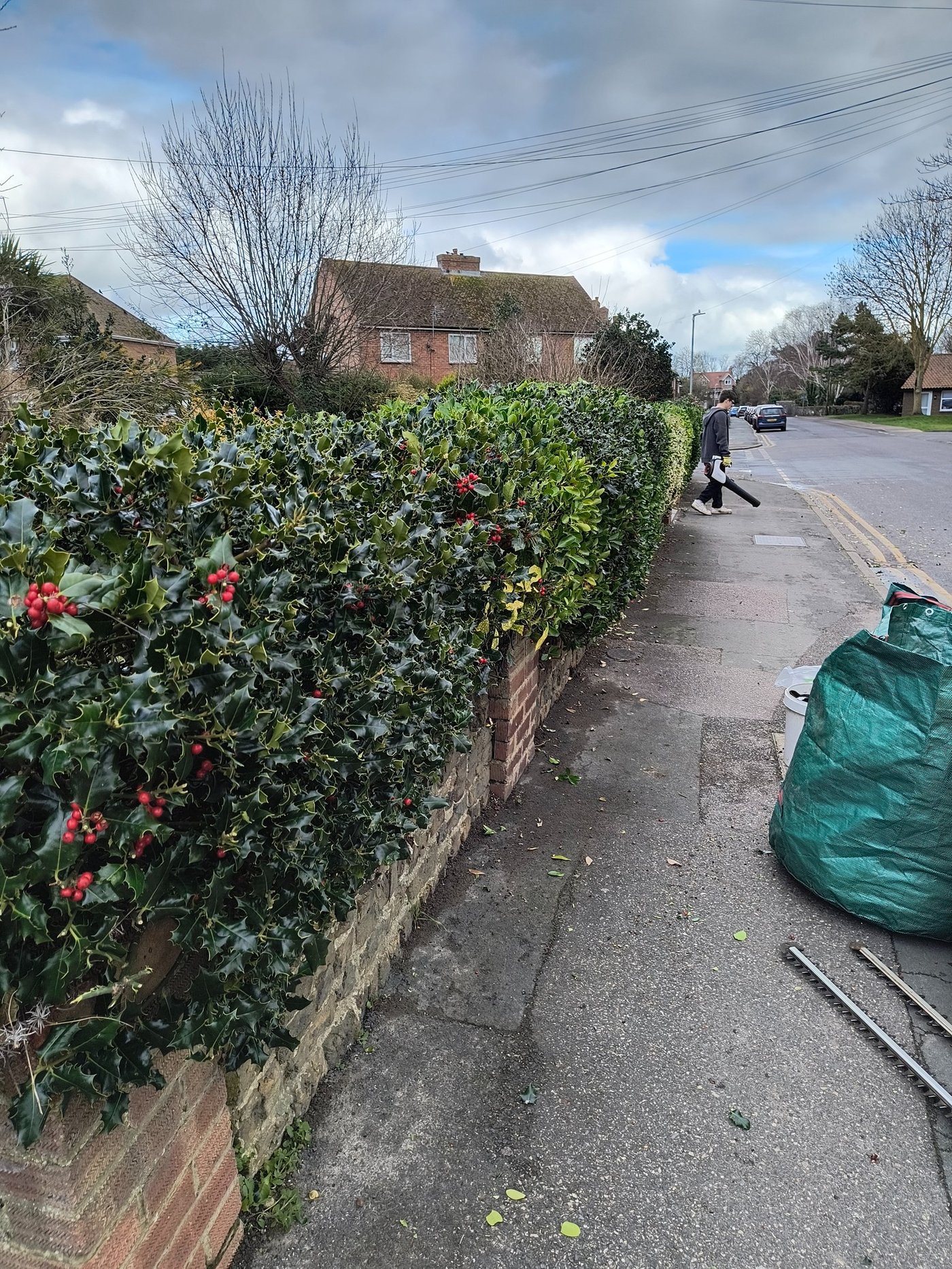
Most garden hedges in East Kent fall into one of three height bands: under 1m (ornamental, kerb-side, decorative), 1m to 2m (the working boundary hedge), or over 2m (tall screening and windbreaks). Each has a distinct set of trade-offs and, once a hedge is established, changing your mind about height means either a multi-year reduction process or starting again. It's worth getting clear on what you actually need before the plant goes in.
The species and the height target should be decided together: a hedge planted today that's meant to reach 2m in five years will, unless it's deliberately managed down, almost certainly exceed that without regular attention. We see a lot of hedges in Sandwich, Deal and the surrounding villages that were planted with good intentions and are now considerably taller than the owner wants.
Under 1 metre: ornamental and low boundary
Low hedges under 1m are primarily ornamental. They define a space without enclosing it. Common uses: separating a front garden from the pavement, dividing a lawn from a planting bed, edging a path. They don't give meaningful privacy, can't be used as a windbreak, and most people could step over them without much effort.
Best for: front garden edging (box, lavender, rosemary, dwarf lonicera), division within a garden where you want definition without enclosure, and anyone who wants a hedge that can be cut from ground level with hand shears alone.
Maintenance: low formal hedges like box need careful, frequent cutting (box benefits from two cuts a year) but the volume of material is small. The main risk with very low, formal hedges is that the top gets cut unevenly and the dips and bumps become obvious. A string line helps.
Legal position: no concerns at this height. Front garden hedges under 1m are almost universally uncontested.
1 metre to 2 metres: the working boundary hedge
This is the most useful height range for a working boundary hedge. At 1.5-1.8m, a seated person in the garden is screened from view from a pavement or neighbouring garden at the same level. At 2m, a standing person is just about screened. It's enough height to create a wind shadow for the first few metres of garden, and the hedge can still be cut from ground level without a ladder for most of this range (the top of a 2m hedge is just within reach with a pole trimmer or a small step).
Best for: most domestic back-garden boundaries, side passages, garden-to-garden divisions, and screening a seating area from public view.
Maintenance: the volume of material grows significantly from 1m to 2m, particularly in width. A 2m hornbeam or beech hedge that is 60cm wide generates a lot of clippings per metre run. Annual cutting is still manageable for most people; you'll need a reliable way of dealing with the clippings.
Species notes: most species perform well in this range. Hornbeam and beech are good choices for deciduous screening with winter interest. Yew is the classic formal hedge for this height. Privet can be kept in this range but needs two or three cuts a year to stay sharp.
Legal position: well within any informal threshold for neighbour disputes. No planning concerns for back-garden hedges in this range.
Over 2 metres: tall screening and windbreaks
Above 2m, the character of the hedge changes. It becomes less a garden boundary and more a landscape element, particularly once it starts to dominate the skyline of a small suburban plot. But in the right situation, a tall hedge earns its keep clearly: full privacy for a garden visible from an overlooking bedroom window, or wind protection for an exposed coastal site.
Best for: screening outbuildings, sheds or unattractive views; creating a proper windbreak on an exposed site; tall boundaries on larger rural plots where scale is appropriate; privacy from a significantly elevated road or neighbour's upper windows.
Maintenance: cutting a hedge over 2m means either a ladder, a pole trimmer, or a professional. For domestic gardens, hedges over 3m tall tend to be handed to a professional team in our experience, partly because of the ladder risk and partly because the volume of material is significant. We cut tall hedges regularly in Woodnesborough and along the coastal edge of Sandwich Bay, where the windbreak function matters more than keeping the height minimal.
Legal position: this is where the law becomes relevant. The Anti-social Behaviour Act 2003 (Part 8) gives councils the power to intervene on high hedges that are blocking light or access to a neighbouring property, where informal resolution has failed. The legislation applies to hedges of two or more evergreen or semi-evergreen trees or shrubs that form a barrier to light. The council considers whether the hedge is "adversely affecting the reasonable enjoyment" of the neighbour's property. See our hedge heights and the law guide for the full detail.
This doesn't mean you cannot grow a hedge taller than 2m. Many gardens have them, they're legal, and plenty of neighbours have no objection. But it does mean there is a legal route available to a neighbour who is genuinely affected, and it's worth knowing about before planting or letting a hedge grow unchecked.
A note on front garden hedges and planning
Front garden hedges bordering a road or public footpath sometimes fall within permitted development rules or local conditions attached to a planning permission. Some councils in Kent have guidance recommending maximum front boundary heights of around 1m for visibility and street character reasons, though enforcement is rare. If your property is in a conservation area or has any planning conditions attached, it's worth a quick call to the local authority before planting something tall at the front.
Height and wind protection: the Kent coastal case
East Kent's position on the south-east coast means exposed gardens, particularly on the seaward side of Sandwich Bay, along the coast at Deal, and on the higher ground around Eastry and Ash, are subject to persistent south-westerly and north-westerly winds. A hedge of 1.5-2m on the windward side of a garden doesn't just provide privacy: it creates a wind shadow that can extend 10-15m downwind, meaningfully reducing the wind chill in a seating area and allowing more tender plants to be grown. The mild coastal winters mean the growing season is longer here than inland Kent, and windbreak planting pays dividends in protected growing space.
For a windbreak on an exposed coastal site, the choice often comes down to beech, hornbeam (for deciduous screens with winter structure) or an evergreen such as yew or holm oak for year-round protection. Leylandii is fast but carries the legal risk of growing beyond 2m and outpacing any agreed target height. For more on the differences between windbreak species, see our windbreak hedge guide.
Worth watching
The Gardening With Alan Titchmarsh channel (185,000 subscribers) has a useful demonstration of pruning and training principles, including how established hedges are managed to a target height and form over time. Alan Titchmarsh has presented BBC Gardeners' World and made garden programmes for ITV over several decades, and the approach reflected in the channel is grounded in practical long-term maintenance rather than short-term appearance.
Making the decision: a simple framework
If you're not sure which height to aim for, three questions usually settle it:
- What are you screening? A passer-by at pavement level needs 1.5m. An overlooking upper-storey window needs 3m or more, and a hedge may not be the practical answer at all.
- How exposed is the site? A sheltered town garden needs less height for comfort than a coastal or elevated rural plot where wind is a factor.
- Who are your neighbours and what's the long-term relationship likely to be? A hedge planted at 1.8m and maintained there is unlikely to cause any friction. A hedge that creeps to 3m over ten years of neglect is a different matter. Build in a realistic maintenance plan when you decide the target height, not just the planting height.
Not sure what height works for your garden?
We're on site in Sandwich, Deal, Worth, Ash, Woodnesborough, Eastry and Sandwich Bay most weeks and can give a plain-English view on what works in your garden and what won't. Send a photo for a free quote or to arrange a site visit.
Related guides
Hedge heights and neighbour law
What the high hedge legislation actually says, how the complaint process works, and what counts as a high hedge.
Read the guide ConifersHow to reduce a conifer hedge height without killing it
The gradual two-to-three season method for bringing an overgrown conifer hedge down to the height you want.
Read the guide