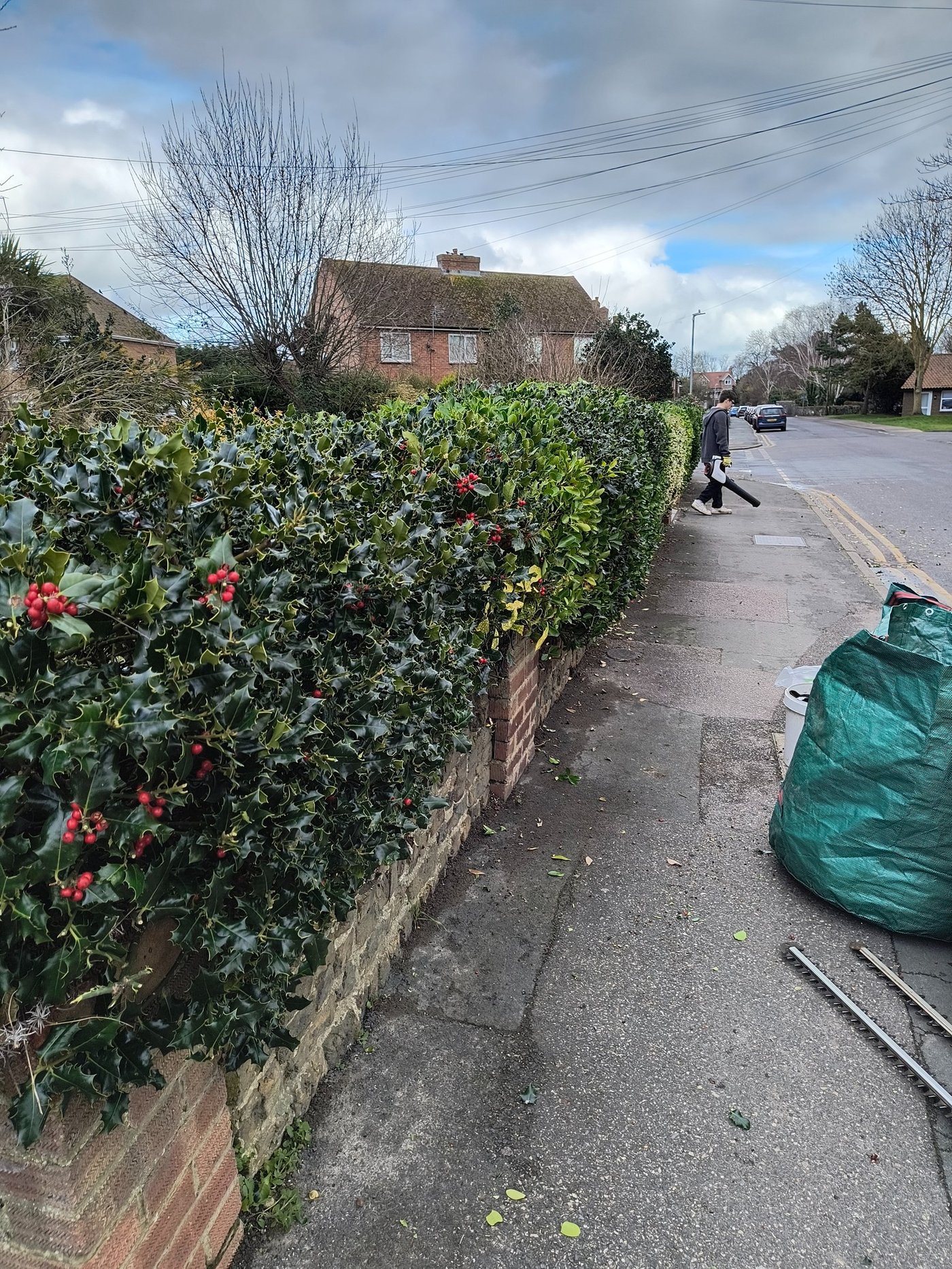
Most people think of hedge cutting as a summer and autumn job. It is, mostly. But January and February deserve a proper place in the plan, because they are the window for renovation work that summer cutting cannot do well. You can see what you are doing on a deciduous hedge when the leaves are off. The plant is dormant, the sap is not running, and hard cuts heal before growth starts in April.
In Kent our winters are mild compared to most of England. Coastal weather from Sandwich Bay and Deal moderates the cold: genuine hard frosts are less common here than in the Midlands, and when they do arrive they rarely last more than a few days. That makes January and February more workable than they sound.
You are in the safe cutting window
The Wildlife and Countryside Act 1981 makes it an offence to damage or destroy an active bird's nest. Nesting season runs roughly from 1 March to 31 August. January and February fall well inside the September to February safe cutting window for most hedges. That said, a quick look before you start is always worth doing: a handful of species, particularly woodpigeons and collared doves, will nest in mild January spells. If there is a bird flying repeatedly in and out of a single spot, leave that section until after 31 August.
Before you start
- Eye protection: flying debris is a real hazard even from dormant, leafless hedges.
- Gloves: thorny deciduous hedges (hawthorn, blackthorn, berberis) are at their most obvious in winter, but still cut skin.
- Ear defenders: if you are using a petrol or electric trimmer.
- Footwear: winter ground is muddy and slippery in East Kent. Ankle support and grip matter more than in summer.
- Ladders: try to avoid them where possible. A long-reach pole trimmer handles most hedges up to about 3.5 m without a ladder. If you do need a ladder, always have someone footing it and never overreach sideways. Wet or frosted rungs are a serious hazard.
- Electric trimmers: use an RCD adapter and keep the cable on the dry side of the hedge.
- Wasps: not a concern in January, but check for old nests if the hedge has not been cut in several years. They are empty, but the papery structure can surprise you.
What the dormant season is good for
Renovation cuts. If a beech hedge has grown a metre taller than you want, or a hawthorn boundary has become too wide and bushy, winter is when you address it. The plant will spend the first weeks of spring pushing new growth from exactly the points you cut, which is how you get a dense, filled-out hedge rather than a thin, leggy one.
The RHS horticulturists make the same point in their guide to hedge cutting technique: the timing of a hard cut matters as much as the cut itself, and dormant-season renovation on deciduous species consistently outperforms the same cut done in summer. Their video guide (see below) covers the technical side of the cut, from angle and direction of cut to how far into old wood is safe to go.
Winter is also when you spot problems you cannot see in summer: crossing branches, weak crotches, sections where the base has thinned out, signs of disease on stems, and any frost damage from the previous winter that needs removing cleanly.
January
Deciduous hedges: the main renovation window
Beech, hornbeam, hawthorn, blackthorn and field maple are all fully dormant in January. This is the best month to reduce their height or width significantly, because you can see the full structure and the cuts will callus cleanly before growth begins. In the chalk and clay gardens around Eastry, Woodnesborough and Ash, beech and hornbeam are both common, and January is ideal for any reduction work that autumn trimming would not address.
Holly: proceed carefully
Holly is technically evergreen but growth slows dramatically in January. You can do modest shaping now. Hard renovation cuts on a very overgrown holly are better left to late January or February, when the worst of the cold is usually past in East Kent. Holly is also a valuable berry source for birds through December, so bear in mind that a January cut removes the remaining berries.
Evergreen broadleaves: light touch or leave
Laurel, privet, photinia and escallonia are all better trimmed in late summer. A hard winter cut leaves the wounds open through the coldest weeks and can cause significant dieback on the cut edges. If you need to do a light tidy for appearance, that is fine. Hard reduction: wait until August or September.
Frost rule
Do not cut any hedge in hard frost. Cut surfaces on evergreens are particularly vulnerable to freeze damage in the hours immediately after cutting. If a frost is forecast, wait. Kent's coastal position usually means frosts are brief, but check the forecast before you start rather than after.
February
The last chance for renovation work
February is the tail end of the dormant season. Deciduous hedges are still fully dormant until the very end of the month, when the first buds start to swell. Get renovation cuts done in the first three weeks of February rather than the last. Once the buds are breaking, hard cuts are more stressful for the plant and the wounds are more visible through the first flush of spring growth.
Yew: a good time for careful shaping
Yew tolerates trimming almost any time it is not frozen, but February is particularly good for shaping because growth has not started. Unlike conifers in general, yew will regenerate from old brown wood, so you have more latitude with the cut than on leylandii or thuja. Even so, do not go drastically hard in one session: take off the obvious overgrowth and let it recover before the next main trim in late summer.
Box: hold off until late May
Box blight risk increases when cuts are made in cold, damp weather. A February cut on box is not ideal. Wait until late May or early June when conditions are warmer and drier. If your box has had blight in previous years, do not cut in wet weather at any time of year.
The hedgehog caution
Hedgehogs hibernate through winter, often in dense hedge bases or piles of leaves at the foot of a hedge. Before digging around the base of a hedge or clearing a large pile of trimmings and leaves, prod gently with a stick first. Disturbing a hibernating hedgehog can be fatal if it happens in prolonged cold spells. If you find one, cover it gently and leave it where it is.
Conifers in winter: what not to do
This is the most common mistake we see. Someone decides January is a quiet period and tackles the leylandii. They cut too hard, go into the brown wood, and nothing grows back. Conifers cannot regenerate from dead wood: once you cut past the green zone, that section stays brown and bare permanently.
For leylandii, thuja, lawson cypress and western red cedar: light shaping only in winter. The main size-management window is May to September, when active growth is happening and the plant can respond quickly. If the conifer hedge needs a significant reduction, that requires either professional work or a very carefully staged approach over several years. Our guide to leylandii care covers the detail.
What neighbours and law applies
Winter work on your own hedge is entirely within your rights. If you are thinking about work on a hedge that sits on a boundary with a neighbour, or if the hedge is on the other side of the boundary, our guide to hedge heights and the High Hedges Act covers the relevant law and how to approach it. The short answer: a neighbour can cut back branches that overhang their side, but only up to the boundary and not onto your land, and the same applies to you. For an evergreen hedge over 2m that is blocking light, a neighbour can complain to the council, which may charge a fee.
Video: RHS on getting the technique right
The Royal Horticultural Society's video guide to hedge cutting technique is a good companion to the seasonal advice here. RHS horticulturist Alesandra Sana covers the angle and direction of cuts, how to work systematically, and why the right technique matters as much as the right timing. The channel is the RHS on YouTube (78,000 subscribers, 17 million views); the specific video is What is the best way to cut a hedge?, published September 2025.
Rather have it done properly?
Winter is actually one of our busiest periods for renovation work, particularly on beech, hornbeam and hawthorn hedges across Sandwich, Deal, Worth, Ash, Woodnesborough, Eastry and Sandwich Bay. Send a photo and we will quote, usually within a day.