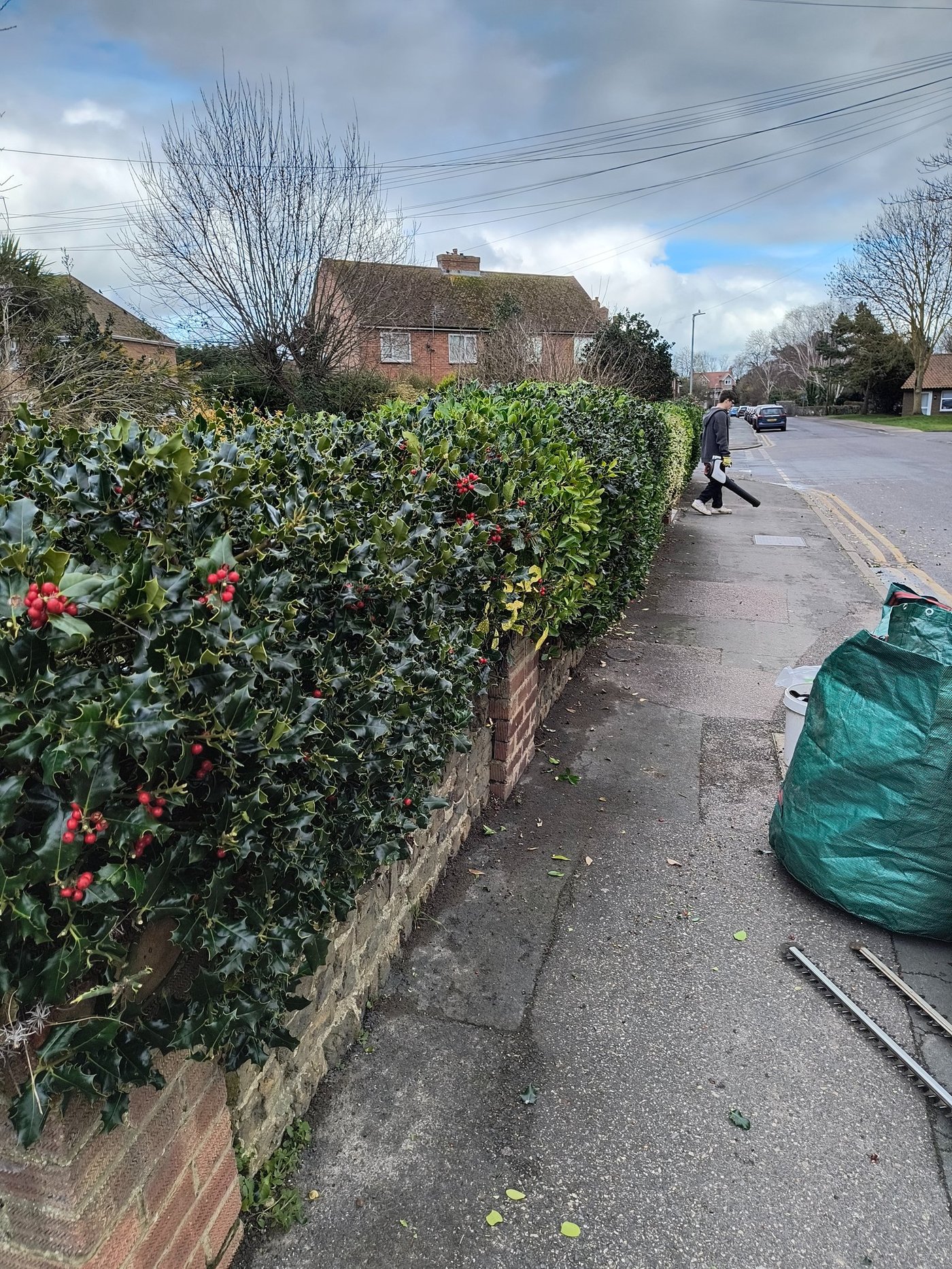
Beech (Fagus sylvatica) is one of the most rewarding hedges you can grow in East Kent. We see them all through the gardens in Worth, Ash, Eastry and the older cottage plots around Sandwich, often forming the backbone of the garden boundary for decades.
People sometimes confuse beech with hornbeam (Carpinus betulus). They look similar, behave in very similar ways, and the advice in this guide applies equally to both. The key thing they share: that distinctive habit of keeping their dead leaves right through winter, which turns copper-bronze and stays on the hedge until new growth pushes them off in spring.
Nesting season: the one rule you cannot ignore
Under the Wildlife and Countryside Act 1981, it is an offence to damage or destroy an active bird's nest. Nesting season runs roughly from 1 March to 31 August. The safe cutting window for beech is September to February. A late-summer trim (late July or August) is acceptable only if you inspect the hedge carefully before you start and confirm it is demonstrably empty.
Before you start
- Eye protection (flying debris from fast-moving blades is a real risk).
- Ear defenders for petrol or electric trimmers.
- Sturdy gloves.
- If using an electric trimmer, plug into an RCD adaptor. Check the cable is clear of the cutting path before every pass.
- For tall hedges, use a pole or long-reach trimmer rather than a ladder wherever possible. If a ladder is unavoidable, have someone footing it, and never overreach sideways.
- Check the hedge base for wasp nests and brambles before you climb or reach in.
When to trim a beech hedge
One cut per year is enough for most established beech hedges. The sweet spot is late July to mid-August. Cut too early and you encourage a second flush of soft growth that can look scruffy by Christmas. Cut in late autumn and you lose the winter-leaf effect because the new cut growth dries and drops rather than curing to that coppery colour.
In Kent, the mild coastal climate means beech comes into leaf a touch later than hedges further inland, and it holds its leaves a little longer in autumn, too. That slightly extended season is actually useful: it means you have a wider window in late summer to get the cut done before the weather turns.
If you only cut once, cut in August. If you want a second tidy, a light pass in late May (before nesting is over, so check carefully first) can knock back the spring flush and keep a very formal hedge looking sharper through summer.
How to cut a beech hedge
Shape: always taper the sides
Cut the sides to a slight A-frame taper, wider at the base and narrower at the top. This is not just for looks. It means light reaches the lower branches, which stay dense and leafy. A hedge trimmed with straight vertical sides gradually goes bare at the base over several years.
Top: flat or gently domed
A flat top is traditional and suits formal gardens. A gently rounded or domed top sheds water better and is more forgiving if the line drifts slightly. Both work well for beech.
Depth of cut
Established beech: cut back to just inside the previous year's growth line. You want to see the light brown colour of last year's stems, not go back into the grey older wood. For maintenance cuts, you are taking off perhaps 10 to 20 centimetres of new growth.
Tools
A powered hedge trimmer works well for beech maintenance cuts. Cordless battery trimmers handle most garden hedges comfortably. If the hedge is taller than you can reach from ground level, a pole/long-reach trimmer is safer than a ladder for getting the top. The RHS team demonstrates hedge cutting technique, including the importance of the tapered cut and working in passes, in their guide below.
Video: "What is the best way to cut a hedge?" by the Royal Horticultural Society (RHS). The RHS is the UK's leading horticultural charity. Watch on YouTube.
Why beech keeps its leaves in winter
The brown leaves are not a sign of disease. Beech and hornbeam both exhibit what botanists call marcescence: the tendency of young wood to hold on to dead leaves rather than forming an abscission layer that drops them cleanly. The leaves cure and dry to a distinctive copper colour through autumn, and stay on until new buds push them off in April or May.
This is actually one of the reasons beech makes such a good hedge, especially in a Kent garden where an exposed boundary needs to screen a prevailing wind or provide some privacy through the winter months. A beech hedge in February still offers considerably more cover than most deciduous alternatives.
Renovating an overgrown beech hedge
Here is where beech has a clear advantage over conifers: it will regrow from old wood. Hard renovation cuts that would kill a leylandii outright will push beech back into new growth from the main stems.
For a large reduction, do it in phases over two or three winters:
- Year one (December to February): Hard-cut one side back to the desired finished line, or close to it.
- Year two (December to February): Once the cut side has leafed up and recovered, hard-cut the other side.
- Year three (if needed): Reduce the top to the new height once both sides are stable.
Do the heavy renovation work in the dormant season (December to February). Autumn cuts are fine for maintenance but leave major reductions until the coldest months when the plant is not in active growth. Avoid cutting in frosty conditions: beech cut edges can brown off and die back in hard frost, especially on new growth.
If a neighbour's beech hedge is causing a problem with height or light, see our hedge heights and neighbour law guide for the legal framework before you take any action.
Beech can look entirely brown and sorry in late February. New growth starts appearing in March. Give it another four weeks before you decide something is wrong.
We can take it off your hands
We trim beech and hornbeam hedges across Sandwich, Deal, Worth, Ash, Woodnesborough, Eastry and Sandwich Bay. Send a photo for a free quote, most hedges booked in the same week.