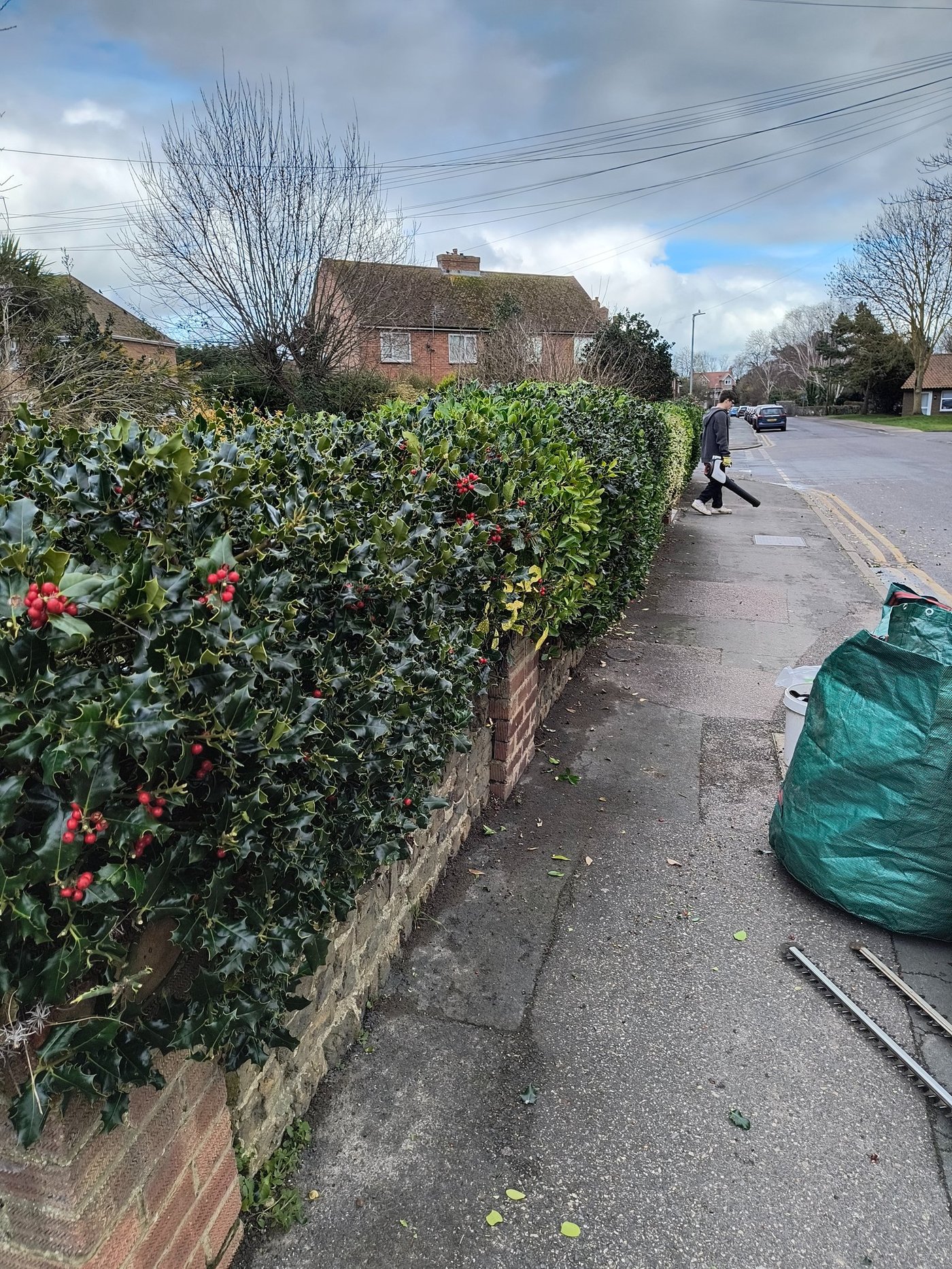
You see yew hedges in churchyards all across East Kent: neat, very dark green, and in some cases several centuries old. There is a good reason they have lasted that long. Yew (Taxus baccata) is one of the toughest and most forgiving hedge plants in the British climate. It grows slowly, tolerates hard cuts, and shapes beautifully. Get the timing and the tools right and it pretty much looks after itself.
Here is what we do on the yew hedges we look after in gardens around Sandwich, Deal, Worth, Ash, Woodnesborough and Eastry.
Before you start: safety
Yew is toxic. Leaves, stems, bark and seeds are poisonous to most animals and to humans. Wear gloves when trimming and handling cuttings, keep cut material away from livestock and children, and wash your hands before eating. The red berries look appealing but the seeds inside are highly toxic.
Beyond the plant itself: wear eye protection against flying fragments, ear defenders if using a petrol or loud electric trimmer, and sturdy gloves. If the hedge is above chest height, prefer a pole or long-reach trimmer over a ladder wherever possible. Ladders cause most garden accidents. If a ladder is unavoidable, have someone footing it and never overreach sideways. For electric trimmers, always plug in via an RCD adaptor. Check for wasp nests and brambles before starting.
Nesting season: check before you cut
Under the UK Wildlife and Countryside Act 1981, it is an offence to damage or destroy an active bird's nest. Nesting season runs roughly 1 March to 31 August. The safe cutting window for yew in most Kent gardens is September to February. If you need to trim during summer, check the hedge carefully from underneath first. If there are birds in residence, you wait.
What makes yew different from other conifers
The key thing to understand about yew is that it is not like leylandii. Cut into bare brown wood on a leylandii and it stays brown permanently. Cut into old wood on a yew, and it will shoot again. This is the exception among conifers, and it means you can reduce an overgrown yew hedge considerably without killing it, as long as the plant is otherwise healthy.
Yew grows slowly, roughly 20 to 30 centimetres a year in good conditions. Expect a little less on Kent's thin chalk and flint soils around Sandwich and Eastry, and somewhat more in richer ground in sheltered inland gardens. The slow growth means less maintenance than privet or laurel, but it also means any shape you cut takes years to fill in if you get it wrong. Take care with the shaping from the beginning.
When to trim a yew hedge
The main cut: late August to September
For most Kent gardens, one cut in late August or early September is enough. The plant still has a little growing season left at that point, which helps the new cut surfaces harden off before the cold arrives. Trimming earlier risks catching soft growth before it has firmed up. Trimming much later than October sends the hedge into winter before the cut ends have settled, which can lead to browning at the tips in a harsh frost.
A second tidy in late February if needed
If a mild Kent autumn has pushed on some extra growth, a lighter second trim in late February keeps things sharp before the new season starts. Keep it light. Save any significant reduction work for this time of year rather than autumn, so the plant has the full growing season ahead of it to recover.
Hard frost: leave it alone
Avoid trimming yew when temperatures are at or below freezing. The cut surfaces can desiccate and the tips will brown. Light frosts on an established hedge are usually fine, but if there is a proper cold snap forecast, leave it until it eases.
Tools for the job
For a formal flat-topped yew hedge up to about a metre wide, a hedge trimmer does the job well. Use a petrol or a good cordless battery trimmer for anything over a couple of metres tall or long. For thick stems (anything over roughly a centimetre in diameter), switch to secateurs or loppers rather than forcing the trimmer blades. Blunted cuts leave ragged edges that take longer to close over.
A string line stretched between canes at the correct height makes a flat top much easier to achieve. Set it, trim down to it, then release and check by eye. Our guide on how to trim a hedge straight covers the string-line method in detail.
Keep the blades clean. Yew's resinous sap builds up on trimmer blades and slows them. Wipe them down with a rag periodically during a long job, and apply a light spray of blade cleaner or oil if they start to drag.
Burncoose Nurseries on yew pruning
Burncoose Nurseries, one of the UK's largest specialist plant nurseries (established in Cornwall in 1984 and affiliated with the RHS), produced a short practical video on pruning yew hedges and topiary. It is worth watching alongside this guide: Pruning a yew / Taxus hedge on the Burncoose YouTube channel.
Reducing an overgrown yew hedge
If you have inherited a yew that has got away from itself, the good news is that you can bring it back. Yew will regenerate from bare wood, which gives you much more freedom than with leylandii or most other conifers.
For a modest reduction (taking off 15 to 30 centimetres from the sides), a single late-summer or late-winter cut is usually fine. The hedge will look a little sparse for one season and then fill in. For a more significant reduction, a two-year approach is more reliable: cut one side hard in February of year one, let it recover through the whole growing season, and take the other side in February of year two. The hedge has deep roots and stored reserves. You are working with the plant, not against it.
See our guide to renovating a neglected hedge for the broader step-by-step on restoration projects.
Shaping: formal hedges and topiary
Yew's density and slow growth make it ideal for formal shapes. Flat tops, bevelled sides, ball finials, spirals, cones: yew handles all of it. The key is to start shaping early, ideally in the first few years after planting, and to trim to the intended final shape consistently each year. Correcting a badly shaped mature yew is possible but takes patience and several seasons.
For topiary shapes within or on top of a hedge, good hand shears give more control than a power trimmer. Work in reasonable light so you can step back frequently and check the shape from multiple angles. Yew holds its shape well between cuts, so precision invested now pays off over years.
If a neighbour's yew hedge is the problem
If a yew hedge on a neighbouring property is over 2 metres tall and you believe it is blocking your light or access, you may have recourse under the High Hedges provisions of the Anti-social Behaviour Act 2003. Our guide to hedge heights and the law covers that process in detail, including what councils can and cannot require.
Common problems
Browning after a cut. Some tip browning on cut surfaces is normal for a few weeks. If it persists and spreads, check for Phytophthora root rot (more likely after very wet winters, particularly on heavier Kent clay soils), or for waterlogging at the roots. Yew does not like wet feet.
Bare patches at the base. Yew naturally sheds lower branches in dense shade. Keep the sides of the hedge slightly tapered (a little wider at the base than the top) to let some light reach the lower growth. Once a bare patch is established it will not fill in naturally, but encouraging the surrounding growth to encroach can help over several seasons.
Very slow growth after a hard cut. Normal. Give the plant a balanced slow-release fertiliser in spring, keep the base clear of competing grass and weeds, and be patient. Yew is a slow plant at the best of times.
Rather we looked after it?
We trim and shape yew hedges across Sandwich, Deal, Worth, Ash, Woodnesborough, Eastry and Sandwich Bay. Send a photo for a free quote. Most hedges booked in within the week.
Related guides
When to trim hedges in Kent
A month-by-month calendar covering all the main hedge species, with nesting dates.
Read the guide Planting & choosingChoosing a hedge species for Kent gardens
How yew compares to beech, privet, leylandii and other common options for East Kent conditions.
Read the guide