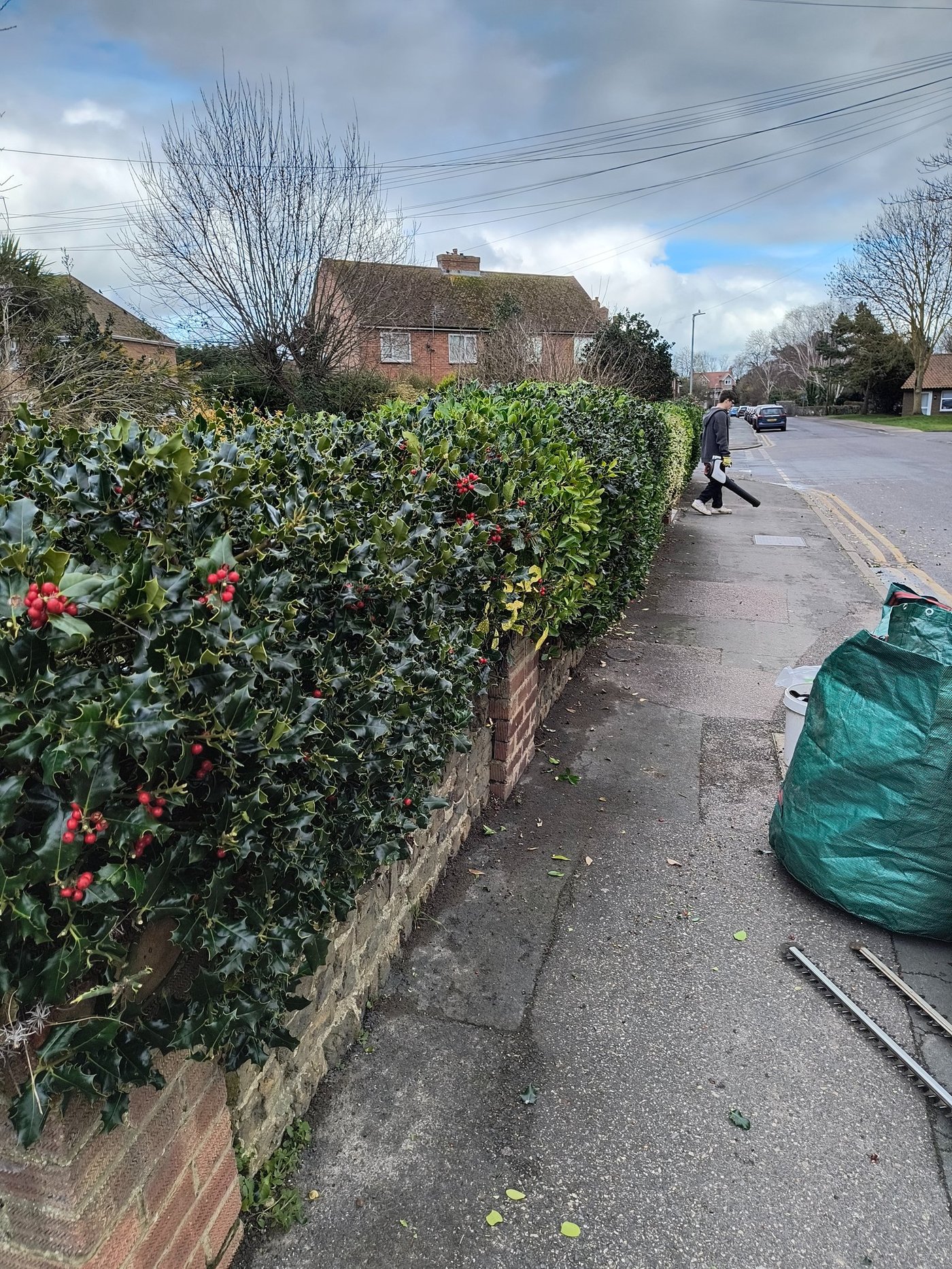
Formal topiary and sculpted hedges are a long tradition in East Kent. The older gardens around Sandwich and the village plots in Worth and Ash often have yew or box shaped into balls, cones or tiered buttresses that have been there for decades. They do not need constant attention, but what they do need is the right tool, at the right time of year.
This guide compares the three main tool options for topiary work and formal hedge shaping, then covers which plants actually hold a shape well in Kent conditions, and when to clip each one.
Nesting season applies to topiary too
Under the Wildlife and Countryside Act 1981, damaging or destroying an active bird's nest is an offence. Nesting season runs roughly from 1 March to 31 August. Holly in particular is a favoured nesting site. Always check any topiary plant or clipped hedge before you start cutting, and wait if you find an active nest. The safe general window is September to February.
Before you start
- Eye protection. Sharp blades move fast and flying debris is a real hazard.
- Ear defenders if using a powered trimmer.
- Sturdy gloves, particularly for holly.
- For electric tools: plug into an RCD adaptor and keep the cable away from the cutting path at all times.
- Prefer a pole or long-reach trimmer over a ladder for tall work. If a ladder is needed, have someone footing it and do not overreach to either side.
- Check for wasp nests in the base of the plant before you get close.
Tool comparison: hand shears vs cordless electric vs petrol
There is no single right answer for every job, so here is how the three main options compare for topiary and shaped hedge work:
| Tool | Best for | Limitations |
|---|---|---|
| Hand shears | Intricate shapes: balls, cones, spirals, small animals. Box, yew and Lonicera. Close detail work where a blade needs to stop precisely. | Slow for large areas. Physically tiring on a big hedge. Not practical for anything taller than you can comfortably reach. |
| Cordless electric | Most topiary and formal hedge maintenance. Good compromise of speed and control. Lightweight enough for overhead work. Pole versions extend reach safely. | Battery life limits long sessions. Not as precise as hand shears for tight curves and small shapes. Blade needs to be kept sharp. |
| Petrol trimmer | Large formal hedges that need power: tall yew hedges, long runs of hornbeam pleaching. No battery constraints. | Heavy. Vibration makes precise topiary work difficult. Overkill for anything smaller than a large formal hedge. Noisy. |
When to use hand shears
Hand shears are the right tool when precision matters more than speed. Box balls, yew cones, small clipped shapes at low height: reach for the shears. Single-handed topiary snips (like a large pair of scissors with long handles) are even better for very tight detail work on box edging.
When to use a cordless electric trimmer
For maintaining the outline of an established topiary shape on a large yew, a flat-topped hornbeam hedge, or a long run of box edging, a cordless trimmer is faster and produces an acceptable finish. Use shears to tidy any edges the trimmer blurs. A cordless pole trimmer handles the top of tall formal hedges without a ladder, which is considerably safer.
When petrol makes sense
A petrol trimmer earns its place on large, established formal hedges of yew or hornbeam where you have a long run of flat-topped hedge at a consistent height. It is not a topiary tool as such, more a maintenance tool for formal hedges at scale.
The RHS covers tool maintenance, plant recommendations and clipping technique in this topiary guide, which is worth watching before you start on a shape you care about:
Video: "The Art of Topiary" by the Royal Horticultural Society (RHS), covering tool maintenance, plant choice and clipping technique. Watch on YouTube.
Best plants for topiary in Kent
Yew (Taxus baccata)
The best all-round topiary plant. Dense, fine-textured, holds a crisp edge through winter, and unlike most conifers it responds from old wood, so you can take a yew shape back hard if it gets away from you. The formal yew hedges and clipped specimens in the older gardens around Sandwich are often 50 to 100 years old. One cut per year, in late August to September, is all they need once established.
Box (Buxus sempervirens)
Traditional for balls, cones, low edging and knot gardens. Still works well in East Kent but increasingly vulnerable to box blight (a fungal disease) and box tree moth caterpillar damage. If you do grow box, clip in late May or early June and again in August, and avoid cutting in wet weather, which spreads blight. Keep it well ventilated. See our guide to box tree moth if you are seeing damage.
Holly (Ilex aquifolium)
Slower to achieve a shape than yew or box, but worth the wait. Holly holds a formal cut well, provides year-round colour and significant wildlife value (berries for birds, cover for nesting). Clip in late summer, wearing thick gloves. The sharp leaves make hand shear work slow but a powered trimmer handles the surface well.
Hornbeam (Carpinus betulus)
Excellent for formal hedges with a pleached or architectural line. Holds a flat top beautifully and retains its dead copper leaves through winter (similar to beech). Less suited to three-dimensional topiary shapes than yew or box, but for a classic formal clipped hedge with crisp angles, hornbeam is superb. Clip in late July or August.
Lonicera nitida (Wilson's honeysuckle)
A faster alternative to box for small shapes. Responds quickly to clipping and can be clipped into balls and domes, though it needs three or four cuts per year to hold a neat shape. Less suited to very crisp geometric lines but useful where you want results quickly.
When to choose a professional
Topiary that has been neglected for several seasons often needs restorative work before a maintenance cut is worth doing. Large established yew shapes, tall formal hedges above about 2 metres, or anything that needs a ladder or scaffolding to clip safely is worth getting professional help for. We cover topiary and formal hedge shaping across Sandwich, Deal, Worth, Ash, Woodnesborough, Eastry and Sandwich Bay.
If a neighbour's formal hedge is causing issues with height or shade, the relevant law is covered in our hedge heights and neighbour law guide.
Got a formal hedge or topiary that needs work?
We clip and shape formal hedges and topiary across East Kent. Send a photo for a free quote. Most jobs booked in the same week.
Related guides
Yew hedge care in Kent
Yew is the best topiary plant: dense, fine-textured and one of the few you can cut hard back and it recovers.
Read the guide DIYHow to trim a hedge straight
The string-line trick, the common mistakes, and how to get a clean flat top without a spirit level.
Read the guide