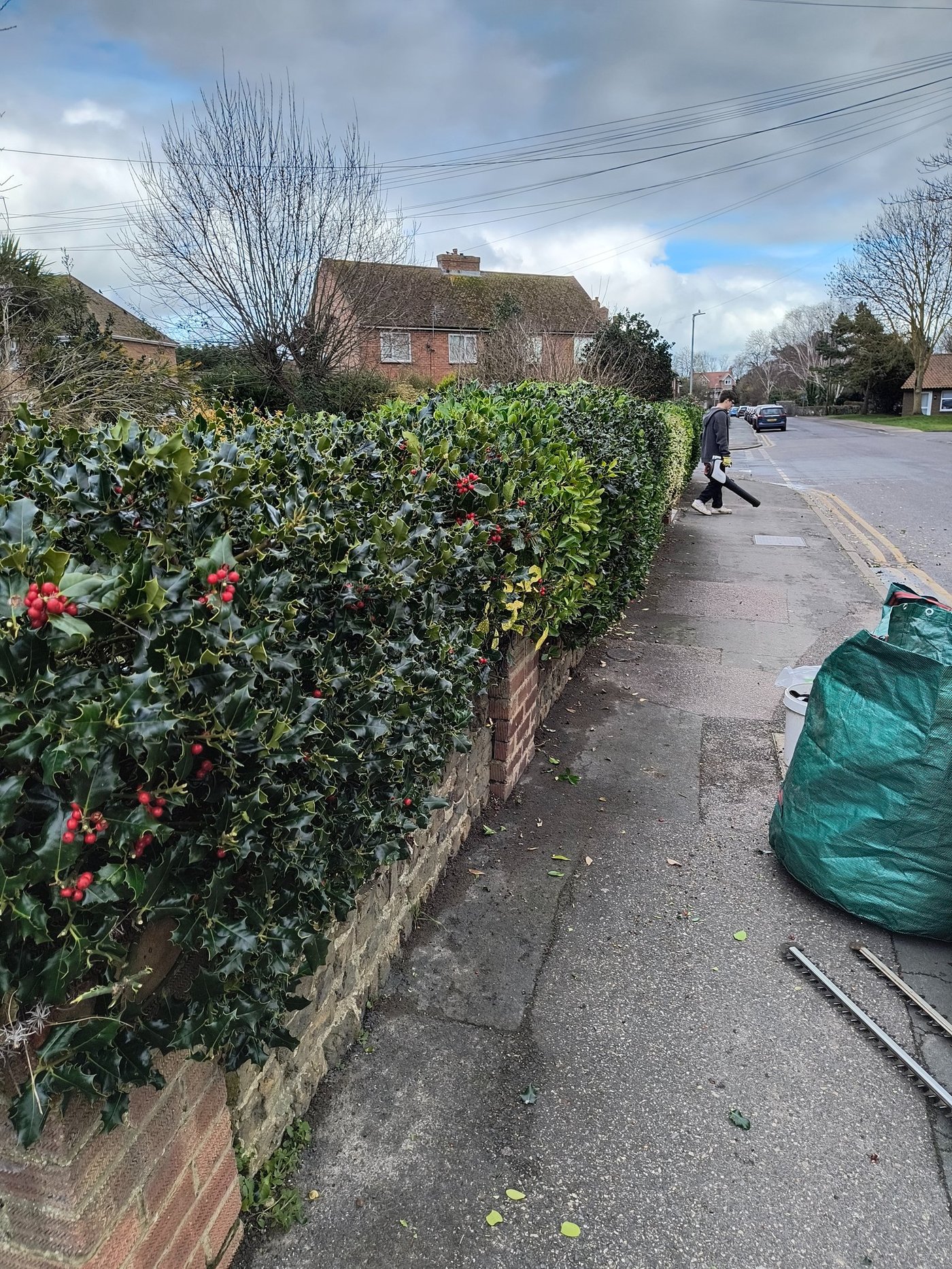
Walk into any garden centre and there are trimmers at every price point, each one apparently capable of being the only tool you need. In practice, a corded electric trimmer and a petrol trimmer are almost different tools for different jobs. The comparison below cuts through that, based on what we actually reach for on different sites.
Before you use any hedge trimmer: safety basics
Hedge trimmers cause serious injuries every year. The same rules apply to all types:
- Eye protection, always. Flying debris and fragments are inevitable.
- Ear defenders for petrol trimmers, and for prolonged use of any powered trimmer.
- Sturdy gloves. Not thin gardening gloves.
- Closed-toe footwear, ideally steel-toed.
- For tall hedges, use a long-reach pole trimmer from the ground rather than a ladder wherever possible. Ladders cause most garden accidents. If a ladder must be used, have someone footing it and never overreach sideways.
- For corded electric trimmers: always plug in through an RCD adaptor. Keep the cable behind you and visible at all times. Never cut when it is raining.
- Check the hedge for wasp nests and brambles before starting.
Do not cut any hedge between 1 March and 31 August without first checking for active bird nests. The UK Wildlife and Countryside Act 1981 makes it an offence to damage or destroy a nest in use. See our month-by-month trimming guide for when it is safe to cut.
The three main types compared
Corded electric trimmer
The lightest option and the cheapest to buy. A corded trimmer is a good choice for a small to medium garden hedge with a socket within reach. It runs indefinitely and the motor is generally consistent.
Works well for: privet, box, beech, young leylandii, laurel on shorter runs (up to 20 to 30 metres of hedge with a good extension lead).
The drawback: the cable. You need to keep it behind you at all times and stay aware of where it runs. Cutting through a live cable is dangerous without an RCD adaptor, and a good length of outdoor extension lead adds cost and something to trip over. In a garden with a winding hedge or a lot of obstacles, cable management becomes frustrating quickly.
Essential accessory: an RCD adaptor plugged between the socket and the extension lead. Not optional.
Cordless battery trimmer
The most popular choice for domestic gardens, and for good reason. A quality cordless trimmer from a reputable brand handles all the common hedge species grown across Kent: privet, beech, leylandii, laurel and yew. No cable to manage, no trip hazard, and modern 36V or higher battery systems are powerful enough for most domestic jobs.
Works well for: essentially all domestic hedge work. For longer hedges (over 30 to 40 metres), you may want a spare battery to avoid stopping mid-job to recharge.
The drawback: runtime. A single battery typically lasts 30 to 60 minutes of continuous cutting, depending on the species and how thick the growth is. Fast-chargers help, but a long Saturday session on a large garden in Woodnesborough or Worth may still require a pause.
Buy into a battery platform: if you already own battery-powered tools from one brand (drill, strimmer, leaf blower), it usually makes sense to stay in that ecosystem so the batteries are interchangeable.
Petrol trimmer
The professional's choice for a reason: unlimited runtime, maximum cutting power, and no cable or battery charge to worry about. Petrol trimmers handle thick stems, dense laurel and long leylandii runs without slowing down.
Works well for: long commercial hedges, renovation cuts on overgrown hedges, laurel with stems thicker than a centimetre, any job where you need to keep going for hours.
The drawbacks: weight (petrol trimmers are significantly heavier than electric equivalents, so arm fatigue sets in faster over a full day), noise, fuel and oil to carry, and maintenance (air filter, spark plug, fuel lines). For a small domestic hedge trimmed once or twice a year, a petrol trimmer is more tool than most people need.
The long-reach (pole) trimmer: a separate consideration
A long-reach trimmer is not a replacement for a standard trimmer but a supplement to it. The cutting head is mounted on a pole, allowing you to trim the top of a tall hedge from the ground. Given that ladders cause the majority of garden accidents, this is a meaningful safety improvement for any hedge over about 1.5 metres tall.
Long-reach trimmers are available in cordless and petrol versions. They are heavier to hold than a standard trimmer of the same power, so technique matters: use your body weight and a pole rest where possible, and work in shorter passes rather than trying to hold the pole extended for long periods. For most domestic gardeners with a tall hedge, hiring a long-reach trimmer for the day is a more practical option than buying one.
BBC Gardeners' World Magazine on trimmer selection
BBC Gardeners' World Magazine, the UK's best-selling gardening magazine, put together a practical buyer's guide to hedge trimmers covering the key decisions in more detail. Worth a look if you are weighing up specific models: Hedge trimmers: Buyer's Guide on the BBC Gardeners' World Magazine YouTube channel.
Which type for which hedge?
| Your hedge | Best option |
|---|---|
| Small garden hedge (privet, box), under 10 metres | Corded electric or cordless |
| Medium hedge (beech, privet), 10 to 30 metres | Cordless (spare battery if available) |
| Dense or thick hedge (laurel, leylandii, large privet) | Cordless high-voltage or petrol |
| Long run of hedge over 30 metres | Petrol or cordless with multiple batteries |
| Hedge over 1.5 metres tall | Add a long-reach trimmer for the top |
| Renovation cut on neglected hedge | Petrol, plus loppers for very thick stems |
Blade length: a quick note
Most domestic hedge trimmers come with blades between 40 and 65 centimetres. Longer blades cover more ground per pass but are heavier and less manoeuvrable. For a small to medium Kent garden hedge (the sort you find in Sandwich, Deal or Worth), a 45 to 55 centimetre blade is enough. If you have a long run of formal hedge, a 60 to 65 centimetre blade reduces the number of passes needed and speeds the job up considerably.
Single-sided blades (cutting on one edge only) are lighter and slightly safer. Double-sided blades are more versatile for back-and-forth strokes. Either is fine for most domestic use.
Maintenance: what the manual says you should do (and actually matters)
A hedge trimmer that is not maintained cuts worse and puts more strain on the motor. Three things actually make a difference:
- Blade cleaning and oiling. Wipe the blades with a rag after each use and apply a light spray of blade oil. Sap from laurel, yew and leylandii gums up the mechanism quickly if left on. Five minutes after the job saves the blades.
- Blade sharpening. A blunt trimmer tears rather than cuts. Most blades can be sharpened with a fine file or sent off for professional sharpening. For domestic use, sharpening once a season is usually enough.
- Battery care (cordless only). Do not store lithium batteries fully discharged. Most brands recommend storing at around 50 to 60% charge in a dry, cool place over winter.
For guidance on using your trimmer to get a clean finish, see our guide on how to trim a hedge straight.
Want us to do it instead?
We bring our own professional-grade kit to every job, across Sandwich, Deal, Worth, Ash, Woodnesborough, Eastry and Sandwich Bay. Send a photo for a free quote. Most jobs booked in within the week.