Ken Crowther, award-winning broadcaster with over 40 years on BBC Radio and a Chartered Institute of Horticulture member, demonstrates hand-cutting technique for ivy and yew hedges in his World Radio Gardening video "Pro gardeningtips 10: Ken Crowther demonstrates hand cutting ivy and yew hedges" (youtube.com/watch?v=IPYYU7d0miQ, published February 2024). The technique he demonstrates is exactly what experienced hedge workers use for close-detail work: choosing the right tool for the situation rather than always defaulting to the loudest one.
When hand tools give a better result: the checklist
Before reaching for the hedge trimmer, run through this list. If any of these apply to the hedge you are about to cut, hand tools are likely the better choice.
- Large-leaved species: Cherry laurel, Portuguese laurel, photinia (Red Robin), griselinia and spotted laurel all have leaves large enough that a trimmer blade cuts across the leaf itself rather than through the stem. The result is a hedge covered in brown half-cut leaves that looks tatty for weeks. Hand shears or secateurs that cut individual stems at the base of each leaf avoid this problem.
- Yew hedges: Yew (Taxus baccata) responds well to hand shearing and is a classic topiary material. The tight growth and firm stems suit the precise control of hand shears or secateurs, and a yew hedge that is hand-cut has a noticeably cleaner finish than one trimmed with a power tool.
- Box hedging and topiary: Box (Buxus sempervirens) is slow growing and responds best to careful shaping work that follows the three-dimensional form. Hand shears and secateurs allow corrections and adjustments that a moving trimmer blade cannot.
- Ivy and climbing plants growing through the hedge: Ivy stems are flexible and wiry. They wrap around trimmer blades and jam them. Hand shears and loppers cut ivy cleanly without the jamming and pulling that damages both the tool and the hedge structure underneath.
- Very small or narrow sections of hedge: Setting up, starting, and safely operating a power trimmer for a two-metre section takes longer than simply cutting it by hand. For short runs, hand tools are quicker overall.
- Hedges with obstacles woven through them: Wire fencing, netting, old posts and canes woven into a hedge will destroy a trimmer blade. Always check what is inside the hedge before starting. Hand tools can navigate around obstacles; a trimmer cannot.
- Work near nest boxes, wildlife habitat structures or delicate plants: Hand tools give you complete control over exactly where each cut lands, which matters when working close to bird boxes, toad habitats or other structures in or near the hedge base.
- Formal topiary shapes: Balls, cones, spirals and other shaped hedging need to be cut by eye and by feel, following the curve of the shape. This is only achievable with hand tools that respond directly to small movements of the wrist.
- Final tidying after a power trim: Even after a good pass with a trimmer, missed shoots, uneven sections and corners that the blade could not reach benefit from a hand-shear tidy-up. Keeping shears to hand while trimming a long hedge makes for a cleaner finish overall.
- Hedges over a public path or in confined spaces: Where falling debris is a concern or where you cannot swing a long-bladed trimmer safely, hand tools let you work at a controlled pace without the additional hazard of a fast-moving blade in a tight space.
Check for nesting birds before you start
The UK Wildlife and Countryside Act 1981 makes it an offence to damage or destroy an active bird's nest. This applies to hand tools just as it does to power trimmers. Nesting season runs broadly from 1 March to 31 August. Check the hedge carefully before starting. Hand cutting does have one advantage here: working section by section, you can check as you go and stop if you find an active nest. See our guide on wildlife-friendly hedge trimming.
Safety with hand tools
Before you start
- Wear sturdy leather or puncture-resistant gloves. Sharp shear blades and secateur tips cause serious cuts, and thorny hedges including hawthorn and blackthorn are particularly hazardous.
- Wear eye protection when cutting holly, hawthorn or any species that will spring cut material toward your face.
- Check inside the base of the hedge for wasp nests before reaching in. Wasps frequently build inside dense hedges and will respond aggressively if disturbed.
- Do not use a step ladder or steps without having it on stable, level ground. If the hedge is too tall to reach safely from the ground, use a proper step platform or hire an access tower rather than working off an unstable position.
- Keep shears closed and pointing away from you when moving around the garden between cuts. Put them down rather than carrying them while doing other tasks.
Hand shears: technique
Hand shears look simple and are often used carelessly as a result. Poor technique produces an uneven cut surface that looks as messy as a badly set trimmer.
Blade position: The flat face of the blade should travel parallel to the plane of the hedge surface you are cutting. The most common mistake is tilting the blade so that one side cuts deeper than the other, which leaves a ridged or washboard surface. Keep the blade face flat to the hedge surface throughout each stroke.
Cutting motion: Use a long, sweeping arc that covers 30-40cm per stroke. Avoid short, chopping movements, which leave a rough cut surface. Let the weight of the shears contribute to the cut rather than forcing them shut with your grip.
Blade sharpness: Blunt shears crush and tear stems rather than cutting cleanly. This is particularly visible on fine-leaved species like box and yew, where blunt shears leave a brown, bruised cut surface. Sharpen the blade with a whetstone or a flat file on the bevelled edge before each trimming session. After sharpening, wipe the blades with an oiled cloth and work them open and closed several times to spread the lubricant evenly.
Position and posture: Work at a height and angle that lets you hold the shears comfortably with your elbow slightly bent and not extended fully. Reaching at full stretch with heavy shears is tiring and produces worse results. Move along the hedge rather than stretching.
Secateurs: when and how to use them on a hedge
Secateurs are the right tool when each cut needs to be placed with precision. They are slower than shears but give complete control over where each cut lands.
Large-leaved hedges: On cherry laurel and photinia, cut each shoot back to a leaf node or lateral stem, rather than cutting across the leaf. This takes longer but leaves the hedge looking tidy immediately, without the weeks of browning half-cut leaves that a trimmer or shears leave behind. Aim to cut just above a leaf node with the cut angled slightly away from the bud, using a sharp bypass secateur rather than an anvil type, which tends to crush the stem rather than cutting it cleanly.
Topiary: On shaped box, yew or holly topiary, secateurs let you follow the curve of the form precisely. Cut individual shoots that have grown past the line of the shape, rather than shearing across the whole surface. Step back regularly to check the shape from two or three metres back, as small errors in a complex shape are much easier to spot from a distance.
Thickness: Secateurs should not be used on stems thicker than about 12-15mm (or whatever the manufacturer's stated capacity is). Forcing secateurs on thick wood damages the blade and crushes rather than cuts the stem. Use loppers for stems in the 15-50mm range and a pruning saw above that.
Specific species: what to use
Yew hedges
Yew is one of the best species for hand shearing. Its firm, dense growth takes a clean cut well. Use hand shears for the flat faces and top, making long smooth strokes. For the corners and any formal shapes, switch to secateurs. Our guide to yew hedge care covers the full picture, including hard renovation cuts.
Box hedges and topiary
Box is slow-growing enough that trimming once a year in late spring or early summer is usually sufficient. Hand shears work well for formal box hedging; secateurs for shaped topiary pieces. Box responds well to precise cutting and holds its shape for the full season after a clean cut. See our guide to topiary and shaped hedge work for detailed guidance on specific forms.
Ivy growing through hedges
For ivy that has woven through a hedge, start with loppers on the structural stems to remove the main bulk, then use hand shears to tidy the surface. Pull ivy out from inside the hedge rather than cutting it close to the hedge surface. Ivy growing in a hedge competes for light and water, and removing it regularly keeps the underlying hedge in better condition.
Holly hedges
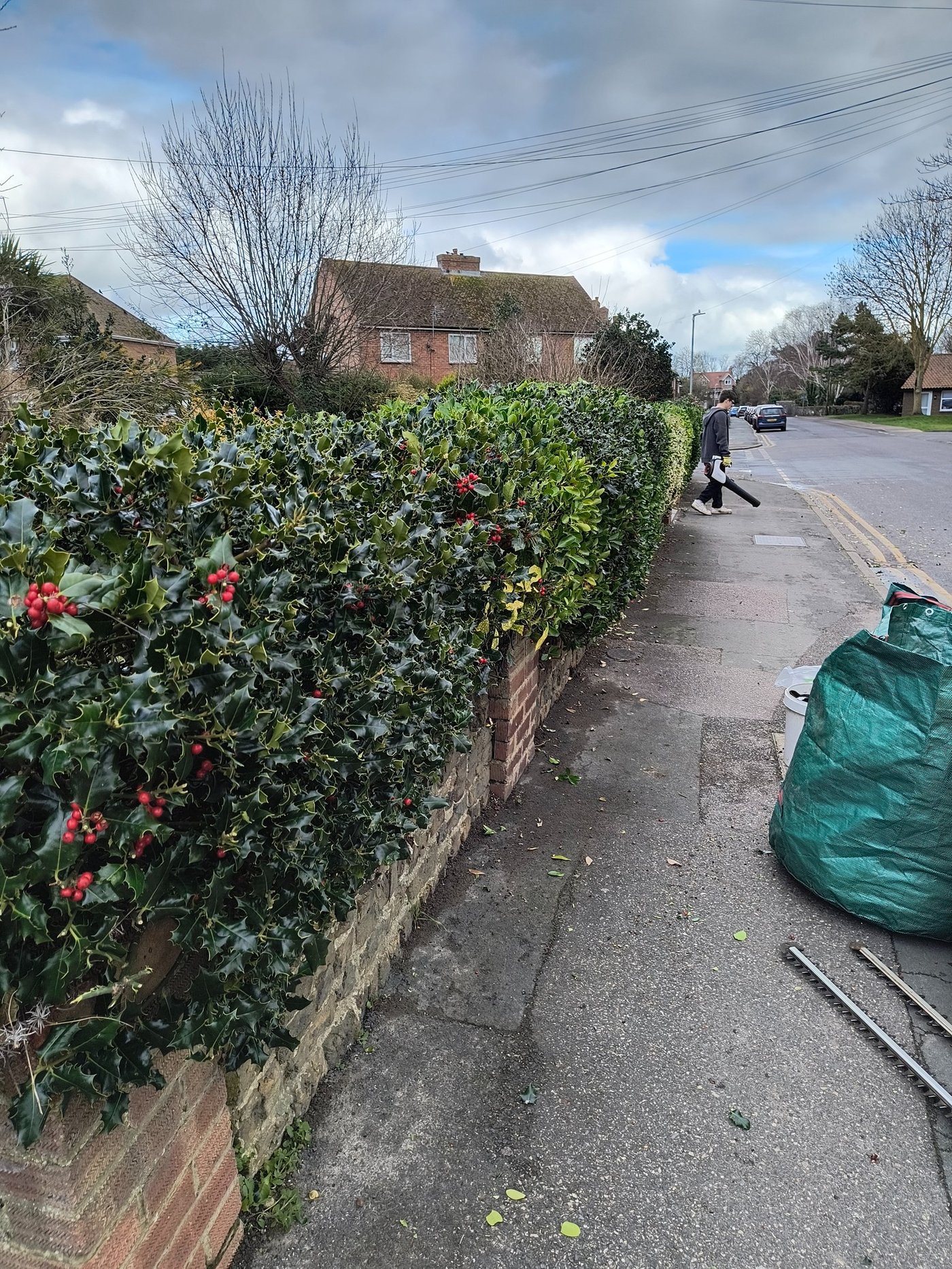
Holly leaves are sharp enough to cause painful hand injuries even through gloves. Use secateurs or long-handled shears to reduce the amount of reaching into the hedge. Sturdy puncture-resistant gloves are essential. The cut holly leaves that fall on the ground remain sharp for weeks, so clear the area after cutting before walking on it.
A hedge trimmer is the right tool for a large, straight privet or beech hedge that needs cutting three times a year. It is the wrong tool for a formal yew box or a large-leaved laurel. Knowing which tool to pick is most of the skill.
Not sure which approach is right for your hedge?
We work with a wide range of hedge species across Sandwich, Deal, Worth, Ash, Woodnesborough, Eastry and Sandwich Bay and are happy to advise. Get in touch or call 07763 100477.
Related guides
Hand shears vs hedge trimmer: which to use
A direct comparison of when to use each tool, covering the hedge types, job sizes and situations where each one is the better choice.
Read the guide DIYSharpening and maintaining hedge shears
How to sharpen hand shears with a whetstone or file, and how to keep them working well throughout the trimming season.
Read the guide