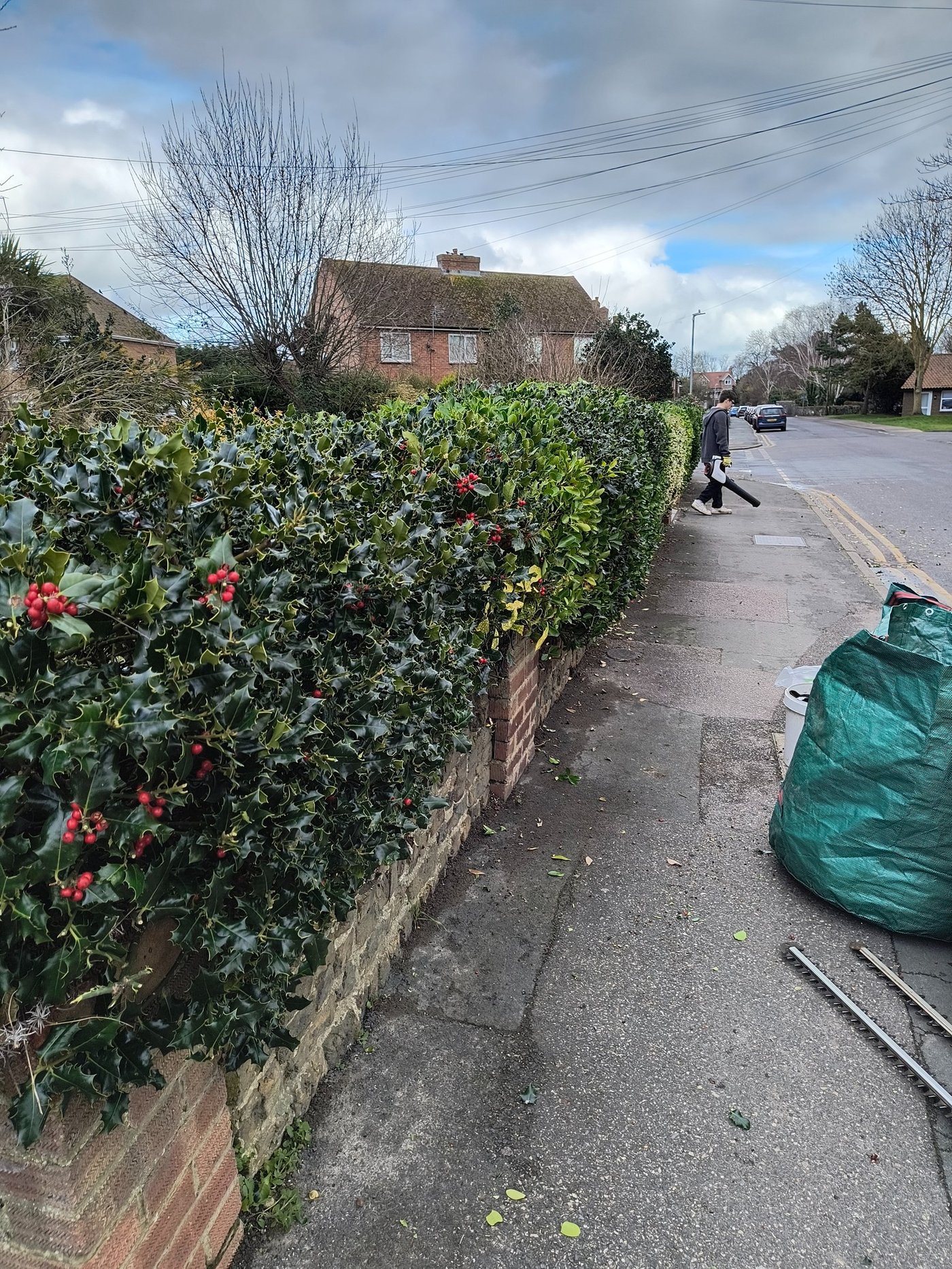
Cutting a hedge is straightforward once you have done it a few times. The first time involves more unknowns than the job itself deserves. What tool? What time of year? How much to take off? Is there anything in there that would make it illegal to cut?
Mark's House and Garden UK covers many of these basics well in their popular video "Hedge Trimming for Beginners | 15 Essential Tips for Hedge Cutting | Gardening UK" (youtube.com/watch?v=tIqbas7abVU). The guide below covers similar ground with East Kent specifics: the locally common species (privet, beech, laurel, leylandii, yew), the local timing conditions (mild coastal winters extending the safe window) and the relevant UK law.
Quick-reference checklist: before you start
Go through this before picking up any tool.
- Is it the right time of year? The safe main cutting window is September to February. Between 1 March and 31 August, cutting without checking for nests is an offence under the Wildlife and Countryside Act 1981.
- Have you checked the hedge for active nests? Walk along the hedge and look carefully. Listen for alarm calls. Do not cut if any section shows birds flying in and out of the same spot. See our full nest-checking guide: checking your hedge for active birds' nests.
- Do you know what species the hedge is? This affects how much you can take off (conifers are unforgiving), what tool to use (laurel is best cut with secateurs or a long-reach trimmer with large blades, not fine-toothed shears) and whether the hedge has thorns to watch for (hawthorn, pyracantha, berberis).
- Do you have the right PPE? Eye protection, sturdy gloves, ear defenders for petrol or electric trimmers.
- Do you have the right tool for the hedge? A cordless battery trimmer for most domestic hedges. A long-reach pole trimmer or a ladder (with someone footing it) for anything over 1.5 metres. See: choosing a hedge trimmer.
- Is your electric cable safe? Any corded trimmer must be plugged into an RCD adaptor, not directly into a socket. Check the cable before starting for cuts or damage.
- Do you have a plan for the clippings? A tarpaulin on the lawn under the hedge saves a lot of raking.
- Is anyone below or nearby where cuttings could fly? Clear the area and warn anyone who might walk past.
The legal rule that catches people out
It is an offence under the UK Wildlife and Countryside Act 1981 to damage or destroy an active bird's nest. Nesting season runs roughly from 1 March to 31 August. The safe cutting window for most hedges is September to February. A summer trim is only acceptable if the hedge is checked and demonstrably empty first. If you are unsure about any hedge on or near your boundary, see our guide on wildlife-friendly hedge trimming.
Know your species: the most common hedges in East Kent
The garden hedges of Sandwich, Deal, Worth, Ash, Woodnesborough and Eastry are mostly these species:
Privet
Fast-growing, semi-evergreen, very forgiving. The most common domestic hedge in East Kent. Takes a cut at any time in the September to February window, and a light summer trim in June if the hedge is clearly empty. Cut it hard and it comes back. Tool: any hedge trimmer works.
Beech and hornbeam
Deciduous but holds its copper-brown leaves through winter. Best cut in late July/August or October. Responds well to a hard renovation. Tool: any hedge trimmer works for the current season's growth; loppers for thicker older stems.
Laurel (cherry laurel and Portuguese laurel)
Large-leaved evergreen. If you use a fine-toothed hedge trimmer on laurel, it shreds the leaves, which then go brown. For a clean finish, use either a long-reach trimmer with wide blade spacing, or secateurs for smaller hedges. Best cut late summer.
Leylandii and other conifers
The most important rule: do not cut back into old, brown wood. Leylandii cannot regenerate from the woody interior. Only cut back into the current year's green growth. A conifer that has been cut back beyond the green is effectively that shape permanently. Full guide: leylandii and conifers.
Yew
Slow-growing, dense, beautiful when shaped well. Tolerates a hard cut better than most. Best cut in late August or September. Yew berries and foliage are toxic to people and animals, so wear gloves and wash hands after cutting.
Box
Usually small and slow-growing. One careful cut in late May or early June and a light tidy in August. Watch for box blight and box tree moth caterpillar, both of which are widespread in Kent. See: box hedge care.
Basic technique
On a first cut, aim for modest results rather than perfection. These three principles cover most of it:
- Sides first, top last. Cutting the sides before the top means any debris from the top cut falls onto the already-cut sides rather than back into the untrimmed growth.
- Slight inward taper on the sides. The hedge should be fractionally narrower at the top than at the base. This allows light to reach the lower growth and keeps the base dense. Even a slight taper (a few centimetres) makes a significant difference over several years. See: hedge cutting profile and batter.
- Use a string line for the top. Run a tight string between two canes at the height you want, and use it as a guide. Step back and check frequently. Going slowly matters more than going precisely. Full technique guide: how to trim a hedge straight.
What to do after
Clear the clippings promptly: left on the lawn they smother the grass. Most soft, leafy clippings can go in the compost heap. Woody material is better chipped or taken to a council garden waste site. Full guide: composting hedge trimmings.
If the hedge looks patchy after the first cut, that is normal. A hedge that has not been cut for some time will take one or two seasons of proper management to regain a dense, even appearance. Keep at it.
The most expensive hedge trim a first-timer ever pays for is the one they did wrong and have to call someone in to fix. Go less hard than you think on the first cut.
Would you rather we took care of it?
We trim hedges across Sandwich, Deal, Worth, Ash, Woodnesborough, Eastry and Sandwich Bay. Most first-time bookings are done in the same week. Send a photo for a free quote.